
Introduction
Soil health is the foundation of productive agriculture.
Many growers focus on fertilizers, but without healthy soil, nutrient efficiency remains low and crop performance is limited.
Humic acid plays a key role in improving soil structure, enhancing nutrient availability, and supporting plant development.
Understanding how humic acid works can help growers achieve more efficient and sustainable crop production.
What Is Humic Acid?
Humic acid is a natural organic compound derived from decomposed plant materials.
It is a key component of soil organic matter and contributes to long-term soil fertility.
Humic substances are widely used in agriculture to improve soil conditions and increase nutrient efficiency.
How Humic Acid Improves Soil Structure
One of the most important functions of humic acid is improving soil structure.
It helps:
- Increase soil aggregation
- Improve soil aeration
- Enhance water retention
- Reduce soil compaction
Well-structured soil allows roots to grow more freely and improves overall plant development.
Enhancing Nutrient Availability
Humic acid plays a critical role in nutrient dynamics.
It helps:
- Improve nutrient retention in the soil
- Reduce nutrient leaching
- Increase micronutrient availability
- Enhance nutrient uptake efficiency
This leads to more effective fertilizer use and reduced nutrient losses.
Supporting Root Development
Healthy roots are essential for crop performance.
Humic acid stimulates:
- Root elongation
- Root branching
- Root activity
Stronger root systems improve water and nutrient absorption, especially under stress conditions.
Improving Soil Biological Activity
Humic acid supports soil microbial life, which is essential for long-term soil health.
Benefits include:
- Increased microbial activity
- Enhanced nutrient cycling
- Improved organic matter decomposition
This creates a more active and balanced soil ecosystem.
When to Use Humic Acid
Humic acid can be applied in various situations:
- Poor soil structure
- Low organic matter soils
- Sandy or degraded soils
- Intensive cropping systems
It is particularly useful as part of a long-term soil improvement strategy.
Recommended Soil Health Solution
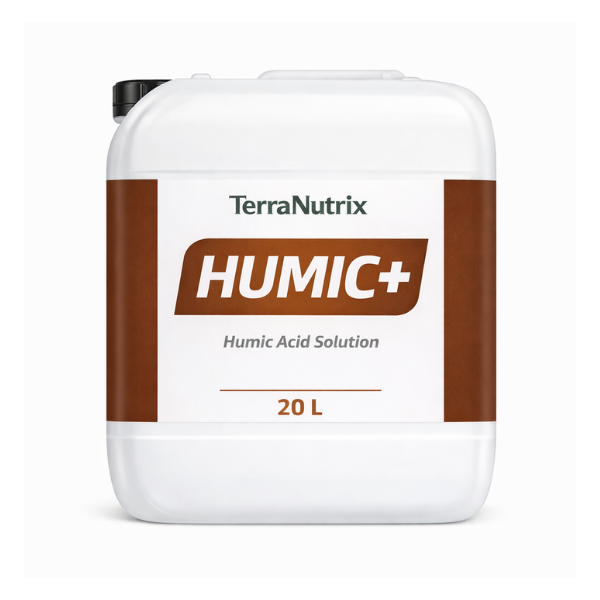
- High-quality humic acid formulation
- Improves soil structure and aggregation
- Enhances nutrient availability
- Supports root development and soil activity
This product is designed to help growers build healthier soils and improve long-term productivity.
Best Practices for Growers
To maximize the benefits of humic acid:
- Apply regularly as part of a soil health program
- Combine with balanced fertilization
- Integrate with irrigation systems when possible
- Monitor soil conditions over time
Conclusion
Humic acid is a powerful tool for improving soil health, nutrient efficiency, and crop performance.
By enhancing soil structure, supporting root development, and improving nutrient availability, humic acid helps create a more productive and sustainable growing environment.
Looking to improve soil health and nutrient efficiency?
Contact TerraNutrix to develop a soil health program tailored to your crops.