
Introduction
Chelated micronutrients have become an essential component of modern fertilizer formulations. Whether developing liquid fertilizers, water-soluble fertilizers, foliar sprays, hydroponic nutrients, or specialty crop nutrition products, fertilizer manufacturers are increasingly choosing chelated forms of iron, zinc, manganese, copper, calcium, and magnesium over conventional inorganic salts.
However, selecting the right chelation technology is not always straightforward.
Today, several chelation systems are widely available, each offering different advantages depending on crop type, fertilizer formulation, application method, production cost, and environmental considerations.
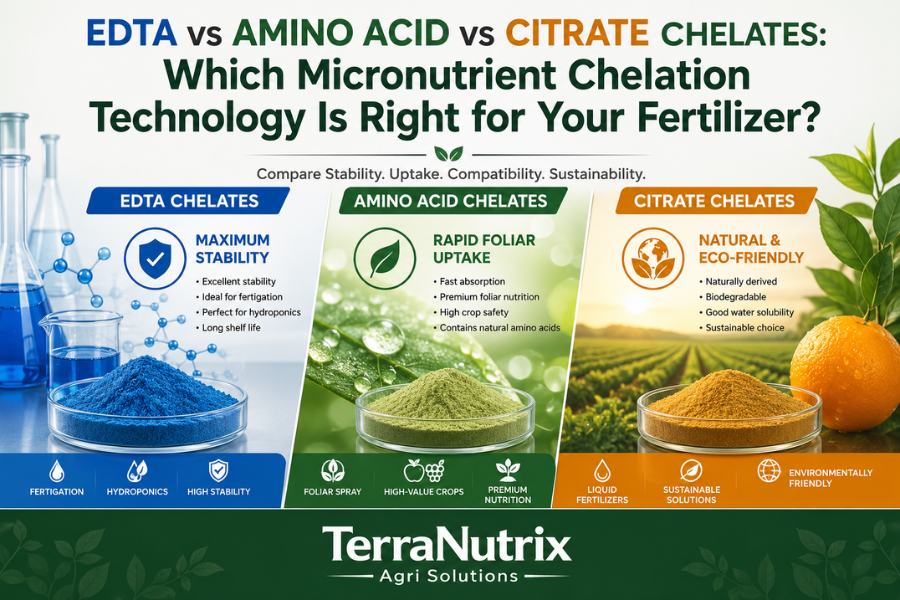
Among them, three technologies dominate the global micronutrient fertilizer market:
Although all three improve nutrient availability compared with inorganic salts, they are designed for different purposes and should not be considered interchangeable.
Understanding the strengths and limitations of each chelation technology enables fertilizer manufacturers to build more stable formulations, improve crop performance, and create products that better match market demand.
In this article, we compare EDTA, amino acid, and citrate chelates from the perspectives of:
- Chemical stability
- Nutrient availability
- Foliar absorption
- Fertigation performance
- Environmental characteristics
- Manufacturing compatibility
- Recommended applications
By the end of this guide, you’ll have a clear understanding of which chelation technology best fits your fertilizer formulation.
What Is Chelation?
Chelation is a chemical process in which a nutrient ion is bound to an organic molecule called a chelating agent.
The chelating molecule surrounds the micronutrient ion, forming a stable complex that protects the nutrient from undesirable chemical reactions before it reaches the plant.
Without chelation, micronutrients such as iron, zinc, manganese, and copper can quickly react with phosphates, carbonates, hydroxides, or other compounds present in fertilizer solutions or soils. Once these reactions occur, the nutrients become insoluble and significantly less available for plant uptake.
A properly selected chelating agent helps keep micronutrients soluble, stable, and available throughout storage, mixing, transportation, and application.
Rather than changing the biological role of the nutrient itself, chelation improves the delivery system, allowing the nutrient to remain available until it can be absorbed by the plant.
Why Chelating Agents Matter
For fertilizer manufacturers, chelation is much more than a technical detail—it directly affects product quality, shelf life, field performance, and customer satisfaction.
A well-designed chelated formulation can improve both manufacturing efficiency and agronomic performance.
Key benefits of chelation include:
- Improved nutrient solubility
- Better compatibility in liquid fertilizer formulations
- Reduced precipitation during storage
- Greater micronutrient availability
- Improved application efficiency
- Better handling during production
- Longer product shelf life
- More consistent crop performance
These benefits become particularly important when manufacturing:
- Liquid fertilizers
- Water-soluble fertilizers
- Foliar fertilizers
- Fertigation products
- Hydroponic nutrient solutions
- OEM and private label fertilizer products
However, not all chelating agents provide the same level of protection or perform equally well under different growing conditions.
Choosing the appropriate chelation technology depends on the specific objectives of the fertilizer formulation.
Understanding the Three Major Chelation Technologies
Although dozens of organic ligands have been studied, commercial micronutrient fertilizers are primarily based on three major chelation technologies:
| Chelation Technology | Primary Strength |
|---|---|
| EDTA | Maximum chemical stability |
| Amino Acid | Rapid foliar uptake |
| Citrate | Natural organic chelation |
Each technology serves a different purpose rather than replacing the others.
Instead of asking “Which chelate is best?”, fertilizer manufacturers should ask:
“Which chelate is best for this specific fertilizer application?”
The following sections explain each technology in greater detail.
EDTA Chelates
The Industry Standard for Micronutrient Stability
For decades, EDTA (Ethylenediaminetetraacetic Acid) has been the most widely used synthetic chelating agent in agricultural fertilizers.
Its popularity comes from one major advantage:
Excellent chemical stability.
EDTA forms stable complexes with many essential micronutrients, including:
- Iron (Fe)
- Zinc (Zn)
- Manganese (Mn)
- Copper (Cu)
- Calcium (Ca)
- Magnesium (Mg)
Because these complexes remain stable in fertilizer solutions, EDTA helps reduce precipitation, maintain product quality during storage, and improve compatibility with other fertilizer ingredients.
For manufacturers producing liquid fertilizers or water-soluble fertilizers, this stability is a significant advantage.
Why Manufacturers Choose EDTA
Many fertilizer producers continue to rely on EDTA because it performs consistently during manufacturing and storage.
Typical advantages include:
Excellent Storage Stability
Micronutrients remain soluble over extended storage periods, reducing sediment formation and maintaining product quality.
Outstanding Compatibility
EDTA chelates are compatible with many liquid fertilizer formulations and blend well with multiple micronutrients.
Reliable Performance in Fertigation
EDTA performs particularly well in fertigation systems where stable nutrient solutions are essential for uniform distribution.
Suitable for Hydroponics
Hydroponic nutrient solutions require highly stable micronutrients.
EDTA helps maintain nutrient availability under controlled growing conditions, making it one of the most common choices in hydroponic formulations.
Broad Commercial Acceptance
Because EDTA has been used successfully for many years, it is well understood by fertilizer manufacturers, distributors, and growers around the world.
Its predictable performance simplifies product development and quality control.
Limitations of EDTA Chelates
Despite its many advantages, EDTA is not the ideal solution for every fertilizer product.
Manufacturers should also consider its limitations.
Less Suitable for Premium Foliar Nutrition
While EDTA chelates are effective in foliar fertilizers, they are not specifically designed to maximize leaf penetration in the way amino acid-based systems are often marketed for premium foliar nutrition.
Environmental Considerations
EDTA is a synthetic chelating agent.
Compared with naturally occurring organic acids or amino acids, it is generally less biodegradable, which may influence product positioning in environmentally focused markets.
Not a Universal Solution for High-pH Soils
Although EDTA improves micronutrient stability compared with inorganic salts, its stability decreases under strongly alkaline soil conditions.
For example, when long-term iron availability is required in calcareous or high-pH soils, EDDHA iron chelates are generally preferred over EDTA because they maintain iron availability more effectively under those conditions.
This distinction is particularly important when formulating iron fertilizers for alkaline soils.
Best Applications for EDTA Chelates
EDTA remains an excellent choice for fertilizer manufacturers producing:
- Water-soluble fertilizers
- Liquid micronutrient fertilizers
- Fertigation products
- Hydroponic nutrient solutions
- Greenhouse fertilizers
- Specialty fertilizer formulations
- OEM fertilizer manufacturing
- Multi-micronutrient blends requiring high formulation stability
For these applications, the stability and compatibility offered by EDTA continue to make it one of the most reliable chelation technologies available.
Amino Acid Chelates
Designed for Rapid Foliar Uptake and Premium Crop Nutrition
Amino acid chelates have become increasingly popular in modern agriculture, particularly in premium foliar fertilizers and specialty crop nutrition products.
Unlike synthetic chelating agents such as EDTA, amino acid chelates utilize naturally occurring amino acids to bind micronutrients. These amino acids not only act as carriers for nutrient ions but may also contribute to improved nutrient transport and reduced plant stress under certain growing conditions.
For fertilizer manufacturers targeting high-value horticultural crops, amino acid chelates provide an attractive alternative to traditional chelates.
Why Manufacturers Choose Amino Acid Chelates
The growing demand for premium crop nutrition products has driven increased adoption of amino acid chelates.
Several characteristics make them particularly suitable for foliar nutrition programs.
Rapid Foliar Uptake
One of the main advantages of amino acid chelates is their suitability for foliar applications.
Because amino acids are naturally occurring compounds in plant metabolism, amino acid chelated micronutrients are widely used in foliar fertilizer formulations where rapid nutrient absorption is desired.
This makes them especially valuable when correcting micronutrient deficiencies during critical crop growth stages.
Why Manufacturers Choose Amino Acid Chelates
The growing demand for premium crop nutrition products has driven increased adoption of amino acid chelates.
Several characteristics make them particularly suitable for foliar nutrition programs.
Rapid Foliar Uptake
One of the main advantages of amino acid chelates is their suitability for foliar applications.
Because amino acids are naturally occurring compounds in plant metabolism, amino acid chelated micronutrients are widely used in foliar fertilizer formulations where rapid nutrient absorption is desired.
This makes them especially valuable when correcting micronutrient deficiencies during critical crop growth stages.
Premium Product Positioning
Many fertilizer manufacturers position amino acid chelates as premium products because they combine micronutrient nutrition with amino acid components.
This creates strong differentiation compared with conventional micronutrient fertilizers.
Premium positioning is particularly attractive in markets focused on:
- Fruits
- Vegetables
- Vineyards
- Greenhouse production
- High-value horticulture
Excellent Crop Safety
Amino acid chelates are commonly used in foliar sprays because they generally exhibit good crop compatibility when applied at recommended rates.
This makes them suitable for repeated applications during sensitive crop growth stages.
Added Biostimulant Value
Unlike EDTA, amino acid chelates contain organic amino acids that are naturally involved in plant metabolism.
Although the primary purpose of the product remains micronutrient nutrition, the presence of amino acids allows manufacturers to develop fertilizer products that combine nutritional and biostimulant-oriented positioning.
For this reason, amino acid chelates are frequently incorporated into premium foliar fertilizer programs.
Limitations of Amino Acid Chelates
Despite their advantages, amino acid chelates are not designed to replace EDTA in every formulation.
Manufacturers should also understand where they perform less effectively.
Lower Stability in Complex Fertilizer Formulations
Compared with EDTA, amino acid chelates generally provide lower long-term chemical stability in highly complex liquid fertilizer formulations.
For products requiring extended storage or maximum formulation stability, EDTA often remains the preferred choice.
Less Suitable for Hydroponics
Hydroponic nutrient solutions require micronutrients that remain chemically stable over long periods.
For this reason, EDTA chelates continue to dominate hydroponic formulations.
Higher Production Cost
Producing amino acid chelated micronutrients typically involves higher raw material costs than conventional inorganic salts and, in many cases, higher costs than EDTA chelates.
Manufacturers should balance the additional value against the target market and product positioning.
Best Applications for Amino Acid Chelates
Amino acid chelates are particularly suitable for:
- Premium foliar fertilizers
- High-value horticultural crops
- Fruit trees
- Vegetables
- Greenhouse production
- Organic-oriented nutrition programs*
- Stress management products
*Always verify local regulations before making organic certification claims.
Citrate Chelates
Natural Organic Chelation for Sustainable Fertilizer Formulations
Citric acid is one of the most widely occurring organic acids in nature.
As a chelating agent, it provides a natural alternative to synthetic chelates while maintaining good nutrient solubility and compatibility in many fertilizer formulations.
In recent years, citrate chelates have attracted increasing attention from fertilizer manufacturers seeking environmentally friendly and cost-effective micronutrient solutions.
Although citrate chelates are generally less chemically stable than EDTA, they offer several practical advantages for liquid fertilizers and foliar nutrition.
Why Manufacturers Choose Citrate Chelates
Naturally Derived Chelation
Citric acid occurs naturally in plants and fruits.
Using citric acid as a chelating agent allows manufacturers to develop fertilizer products that emphasize naturally derived ingredients and environmentally conscious formulations.
Excellent Biodegradability
One of the biggest advantages of citrate chelates is their biodegradability.
Compared with synthetic chelating agents, citric acid is readily broken down in the environment, making it attractive for fertilizer companies focusing on sustainable product development.
Good Water Solubility
Citrate chelates dissolve readily in water and are well suited for:
- Liquid fertilizers
- Foliar fertilizers
- Water-soluble fertilizers
- Specialty micronutrient formulations
Their good solubility simplifies manufacturing and improves handling during production.
Cost-Effective Formulations
For some fertilizer products, citrate chelates provide an effective balance between performance, formulation flexibility, and production cost.
This makes them an attractive option for manufacturers seeking environmentally friendly products without significantly increasing formulation complexity.
Limitations of Citrate Chelates
Like every chelation technology, citrate chelates have limitations.
Lower Chemical Stability Than EDTA
Although citrate chelates improve nutrient availability compared with inorganic salts, they generally do not provide the same level of long-term chemical stability as EDTA chelates.
For formulations requiring maximum stability during storage or under demanding conditions, EDTA remains the preferred option.
Not Intended for Highly Alkaline Soil Applications
Citrate chelates should not be viewed as replacements for highly stable chelates in difficult soil conditions.
For example:
- EDTA generally provides greater formulation stability.
- EDDHA remains the preferred choice for iron nutrition in calcareous or high-pH soils.
Selecting the appropriate chelating agent should always consider the intended application rather than assuming one technology is universally superior.
Best Applications for Citrate Chelates
Citrate chelates are particularly suitable for:
- Liquid fertilizer manufacturing
- Foliar fertilizers
- Specialty crop nutrition
- Sustainable fertilizer products
- Environmentally focused product lines
- OEM fertilizer manufacturing
- Cost-effective premium formulations
Side-by-Side Comparison
| Feature | EDTA Chelates | Amino Acid Chelates | Citrate Chelates |
|---|---|---|---|
| Primary Strength | Excellent Stability | Rapid Foliar Uptake | Natural Organic Chelation |
| Chemical Stability | ★★★★★ | ★★★☆☆ | ★★★★☆ |
| Foliar Performance | ★★★★☆ | ★★★★★ | ★★★★☆ |
| Fertigation Performance | ★★★★★ | ★★★☆☆ | ★★★★☆ |
| Hydroponic Suitability | ★★★★★ | ★★☆☆☆ | ★★★☆☆ |
| Biodegradability | ★★☆☆☆ | ★★★★★ | ★★★★★ |
| Environmental Profile | Good | Excellent | Excellent |
| Storage Stability | ★★★★★ | ★★★☆☆ | ★★★★☆ |
| Liquid Fertilizer Compatibility | ★★★★★ | ★★★★☆ | ★★★★☆ |
| Premium Product Positioning | ★★★★☆ | ★★★★★ | ★★★★☆ |
| Typical Target Market | Water-Soluble & Fertigation Products | Premium Foliar Nutrition | Sustainable Liquid Fertilizers |
Important: No single chelation technology is universally superior. The best choice depends on the formulation goals, application method, target crops, storage requirements, production cost, and desired market positioning.
Choosing the Right Chelate by Application
Instead of selecting a chelating agent based on popularity alone, manufacturers should match the technology to the intended product.
Choose EDTA Chelates when your priority is:
- Maximum formulation stability
- Fertigation systems
- Hydroponic nutrients
- Long shelf life
- Multi-micronutrient blends
- Large-scale liquid fertilizer production
Choose Amino Acid Chelates when your priority is:
- Premium foliar fertilizers
- High-value horticultural crops
- Rapid correction of micronutrient deficiencies
- Products with added biostimulant positioning
- Greenhouse production
Choose Citrate Chelates when your priority is:
- Sustainable fertilizer products
- Naturally derived ingredients
- Biodegradable formulations
- Cost-effective liquid fertilizers
- Environmentally friendly product positioning
Which Chelate Is Best for Different Fertilizer Products?
Choosing the appropriate chelation technology is not simply a matter of selecting the strongest chelate. The optimal choice depends on the product’s intended application, target market, formulation requirements, and production objectives.
Below are some common formulation scenarios and the chelation technologies typically best suited for each.
Liquid Micronutrient Fertilizers
Recommended: EDTA Chelates or Citrate Chelates
Liquid fertilizers require excellent water solubility and compatibility with multiple nutrients.
- EDTA is preferred when maximum formulation stability and long storage life are required.
- Citrate is an excellent alternative for manufacturers developing environmentally friendly or naturally positioned liquid fertilizers.
Water-Soluble Fertilizers
Recommended: EDTA Chelates
Water-soluble fertilizers are often stored for extended periods and frequently mixed with other nutrients.
EDTA provides:
- Excellent storage stability
- Reliable nutrient compatibility
- Low precipitation risk
- Consistent performance during dissolution
Premium Foliar Fertilizers
Recommended: Amino Acid Chelates
Foliar fertilizers are designed for rapid nutrient correction.
Amino acid chelates are commonly selected because they combine micronutrient nutrition with amino acid-based formulations that fit premium foliar product positioning.
Typical target crops include:
- Vegetables
- Fruit trees
- Vineyards
- Greenhouse crops
- High-value horticulture
Fertigation Products
Recommended: EDTA Chelates
Fertigation systems require nutrients that remain soluble throughout irrigation equipment and application.
EDTA provides excellent stability during:
- Tank mixing
- Irrigation
- Nutrient transport
making it one of the most reliable choices for fertigation products.
Hydroponic Nutrient Solutions
Recommended: EDTA Chelates
Hydroponic systems require consistent nutrient availability throughout the crop cycle.
Because nutrient precipitation can quickly affect crop performance, highly stable chelates are preferred.
EDTA remains one of the industry’s most widely used chelation technologies for hydroponic micronutrients.
Sustainable Fertilizer Products
Recommended: Citrate Chelates
Manufacturers developing environmentally focused fertilizer products often prefer citrate chelates because citric acid is:
- Naturally occurring
- Biodegradable
- Suitable for environmentally conscious product positioning
This makes citrate chelates attractive for sustainable fertilizer portfolios.
High-pH Soil Iron Fertilizers
This application deserves special attention.
Neither EDTA nor citrate chelates should be considered the first choice for supplying iron in strongly alkaline or calcareous soils.
Instead:
EDDHA Iron Chelates are generally preferred because they maintain iron availability much more effectively under high-pH conditions.
This is one reason TerraNutrix offers both EDTA Chelated Nutrients and EDDHA Iron Chelates as separate product categories.
Comparison Summary
Every chelation technology has its own strengths.
Rather than competing directly with one another, they complement different fertilizer strategies.
| If Your Priority Is… | Recommended Chelate |
|---|---|
| Maximum formulation stability | EDTA |
| Hydroponics | EDTA |
| Fertigation | EDTA |
| Long shelf life | EDTA |
| Premium foliar nutrition | Amino Acid |
| High-value horticulture | Amino Acid |
| Sustainable formulations | Citrate |
| Environmentally friendly positioning | Citrate |
| Cost-effective premium liquids | Citrate |
| High-pH soil iron correction | EDDHA (Not EDTA or Citrate) |
The most successful fertilizer manufacturers often use multiple chelation technologies across their product portfolio instead of relying on a single system.
Frequently Asked Questions
Which chelating agent is the most stable?
Among the three technologies discussed in this article, EDTA generally provides the highest chemical stability in fertilizer formulations and is widely used in liquid fertilizers, water-soluble fertilizers, fertigation, and hydroponic nutrient solutions.
Are amino acid chelates better than EDTA?
Not necessarily.
Amino acid chelates and EDTA are designed for different applications.
EDTA is generally preferred for formulation stability and hydroponic systems, while amino acid chelates are commonly used in premium foliar nutrition where rapid nutrient uptake is a key objective.
Are citrate chelates environmentally friendly?
Yes.
Citric acid is a naturally occurring organic acid and is readily biodegradable.
For this reason, citrate chelates are often selected for fertilizer products emphasizing environmental sustainability.
Can EDTA chelates be used for foliar spraying?
Yes.
EDTA chelates are widely used in foliar fertilizers.
However, manufacturers seeking premium foliar products may also consider amino acid chelates because they are specifically positioned for foliar nutrition programs.
Which chelate is best for liquid fertilizers?
It depends on the formulation goals.
- EDTA is generally preferred when maximum stability and compatibility are required.
- Citrate is an excellent option for environmentally friendly liquid fertilizer formulations.
- Amino acid chelates are commonly used in premium foliar liquid fertilizers.
Can different chelation technologies be used together?
Yes.
Many fertilizer manufacturers combine different chelated nutrients within their product portfolios to serve different crops, application methods, and market segments.
The appropriate combination should always be evaluated during formulation development to ensure compatibility and performance.
Is EDTA suitable for high-pH soils?
For most micronutrients, EDTA performs well under many growing conditions.
However, for iron nutrition in strongly alkaline or calcareous soils, EDDHA iron chelates are generally the preferred solution because they maintain iron availability more effectively under high-pH conditions.
Which chelation technology is most suitable for OEM fertilizer manufacturing?
The answer depends on the customer’s product objectives.
Many OEM manufacturers offer all three technologies:
- EDTA for high-stability formulations
- Amino Acid for premium foliar products
- Citrate for sustainable and environmentally focused fertilizer lines
Offering multiple chelation options allows brands to develop more diverse product portfolios.
Why TerraNutrix?
At TerraNutrix, we understand that no single chelation technology is suitable for every fertilizer formulation.
That is why we offer a comprehensive range of chelated micronutrient ingredients, enabling fertilizer manufacturers to select the most appropriate solution for their technical and commercial objectives.
Our ingredient portfolio includes:
- EDTA Chelated Nutrients
- Amino Acid Chelated Nutrients
- Citrate Chelated Nutrients
- EDDHA Iron Chelates
- Customized Micronutrient Blends
- OEM & Private Label Manufacturing
Whether you are developing a premium foliar fertilizer, a liquid micronutrient concentrate, a hydroponic nutrient solution, or a specialty fertilizer line, our technical team can help you identify the most suitable chelation technology for your formulation.
Conclusion
Chelation technology plays a critical role in determining the performance, stability, and market positioning of modern micronutrient fertilizers.
Rather than asking which chelating agent is universally “best,” manufacturers should evaluate the intended application, formulation requirements, target crops, environmental goals, and customer expectations.
In general:
- EDTA Chelates remain the industry benchmark for formulation stability, fertigation, hydroponics, and long shelf life.
- Amino Acid Chelates are well suited to premium foliar fertilizers and high-value crop nutrition where rapid uptake and differentiated product positioning are desired.
- Citrate Chelates provide a naturally derived, biodegradable alternative for sustainable fertilizer formulations and environmentally conscious product lines.
By selecting the right chelation technology for each product, fertilizer manufacturers can improve formulation performance, strengthen product differentiation, and better meet the evolving needs of growers around the world.
Explore TerraNutrix Chelated Nutrient Ingredients
Looking for reliable chelated micronutrient ingredients for your fertilizer formulations?
Explore our complete ingredient portfolio:
- EDTA Chelated Nutrients
- Amino Acid Chelated Nutrients
- Citrate Chelated Nutrients
- EDDHA Iron Chelates
- Custom OEM & Private Label Solutions
Our team is ready to help you build stable, high-performance fertilizer products tailored to your market.