
Introduction
Iron deficiency is one of the most common micronutrient problems affecting crops worldwide, especially in alkaline and calcareous soils. While many iron fertilizers are available, selecting the wrong iron source often results in poor performance, wasted fertilizer, and dissatisfied growers.
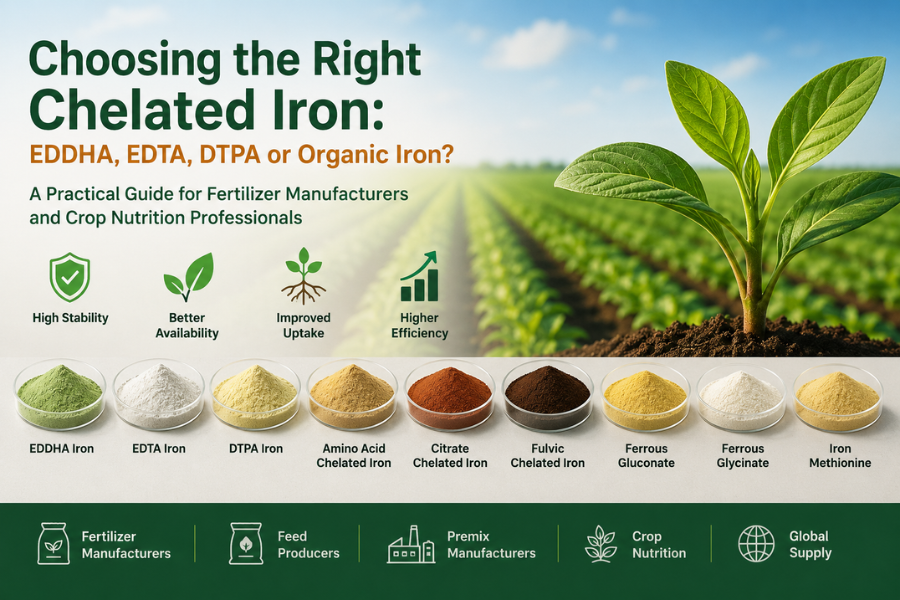
Today, fertilizer manufacturers have access to several iron technologies, including EDDHA, EDTA, DTPA, amino acid chelates, fulvic chelates, citrate chelates, and organic iron complexes. Each performs differently depending on soil conditions, crop requirements, formulation type, and application method.
Understanding these differences helps manufacturers choose the right ingredient for every fertilizer product.
Why Different Iron Sources Matter
Iron availability is strongly influenced by soil pH.
As soil pH increases, soluble iron rapidly converts into insoluble forms that plants cannot absorb. This is why chlorosis frequently occurs in high-pH soils even when total iron levels are high.
Different chelating technologies are designed to keep iron available under different conditions.
EDDHA Iron Chelate
Best for:
- High-pH soils
- Calcareous soils
- Permanent crops
- Citrus
- Vineyards
- Open-field agriculture
Advantages
✔ Highest pH stability
✔ Long-lasting availability
✔ Excellent root uptake
Limitations
- Higher cost
- Usually unnecessary for acidic soils
EDTA Iron
Best for:
- Hydroponics
- Greenhouses
- Acidic soils
- Liquid fertilizers
Advantages
✔ Excellent water solubility
✔ Cost-effective
✔ Ideal for fertigation
Limitations
Performance decreases above pH 6.5.
DTPA Iron
Best for:
- Slightly alkaline soils
- Greenhouse production
- Professional fertigation
Advantages
✔ Better alkaline stability than EDTA
✔ Excellent compatibility
✔ Reliable greenhouse performance
Amino Acid Chelated Iron
Best for:
- Foliar fertilizers
- Specialty fertilizers
- Stress management products
Advantages
✔ Rapid absorption
✔ Excellent leaf compatibility
✔ Suitable for premium formulations
Citrate Chelated Iron
Best for:
- Liquid fertilizers
- Cost-sensitive products
- Neutral soils
Advantages
✔ Natural organic acid
✔ Excellent compatibility
✔ Environmentally friendly
Fulvic Chelated Iron
Best for:
- Organic-based fertilizers
- Biostimulant formulations
- Premium specialty nutrition
Advantages
✔ Natural carrier
✔ Improves nutrient mobility
✔ Supports root activity
Ferrous Gluconate
Mainly used in:
- Feed additives
- Nutritional ingredients
- Specialty industrial formulations
Ferrous Glycinate
Mainly used in:
- Premium feed
- Animal nutrition
- Mineral premixes
High bioavailability makes it a preferred organic iron source.
Iron Methionine
Mainly used in:
- Poultry
- Swine
- Aquaculture
- Premium feed formulations
Offers excellent amino acid utilization together with iron supplementation.
Comparison Table
| Product | Best Application | Recommended pH | Primary Industry |
|---|---|---|---|
| EDDHA Iron | High-pH soils | 4–10 | Agriculture |
| EDTA Iron | Hydroponics | <6.5 | Agriculture |
| DTPA Iron | Greenhouse | <7.5 | Agriculture |
| Amino Chelated Iron | Foliar Spray | All | Agriculture |
| Citrate Chelated Iron | Liquid Fertilizer | Neutral | Agriculture |
| Fulvic Chelated Iron | Organic-Based Fertilizers | All | Agriculture |
| Ferrous Gluconate | Nutrition | — | Feed/Food |
| Ferrous Glycinate | Feed Premix | — | Feed |
| Iron Methionine | Premium Feed | — | Feed |
Which Iron Ingredient Should You Choose?
There is no universal iron source suitable for every fertilizer or nutrition product.
Instead, manufacturers should select iron ingredients based on:
- Soil pH
- Crop type
- Fertilizer formulation
- Application method
- Target market
- Product positioning
A complete ingredient portfolio enables manufacturers to develop solutions for virtually every agricultural and nutritional application.
Conclusion
At TerraNutrix, we supply a comprehensive range of chelated and organic iron ingredients, covering agriculture, fertilizer manufacturing, feed additives, and specialty nutrition.
Whether you require EDDHA for alkaline soils, EDTA for hydroponics, amino acid chelates for foliar nutrition, or organic iron sources for feed applications, our technical team can help you identify the most suitable solution for your formulation.