
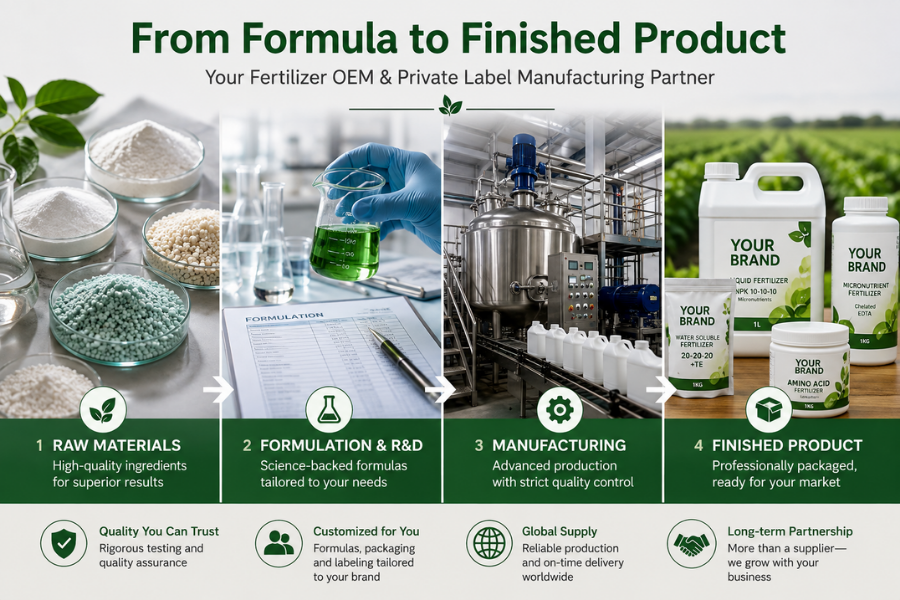
Launching a fertilizer product does not always require building your own manufacturing facility.
For fertilizer brands, distributors, agricultural input companies, turf and ornamental suppliers, and other crop nutrition businesses, OEM and private label manufacturing can provide a practical route from a product idea to a commercially packaged fertilizer.
But what actually happens between the first conversation with a manufacturer and the delivery of the finished product?
The process involves much more than simply choosing a fertilizer formula.
Raw materials, formulation compatibility, production technology, packaging, minimum order quantities, quality control, labeling, logistics, and regulatory requirements can all influence whether an OEM project is commercially viable.
This guide explains the typical fertilizer OEM and private label process—from the initial product concept to commercial production.
What Is Fertilizer OEM Manufacturing?
OEM stands for Original Equipment Manufacturer.
In the fertilizer industry, OEM manufacturing generally means that a manufacturer produces a fertilizer or crop nutrition product according to specifications agreed with another company.
The customer then sells the product under its own brand or commercial identity.
Depending on the project, the manufacturer may be responsible for:
- Raw material sourcing
- Formulation development
- Blending or reaction
- Liquid or powder production
- Filling
- Packaging
- Label application
- Quality control
- Finished-product preparation
The level of customization can vary considerably.
Some customers already have a complete formulation and simply need manufacturing capacity.
Others begin with only a product concept, such as:
“We need a liquid zinc product for high-pH soils.”
or:
“We want a private label micronutrient package for turf applications.”
In these cases, product development may begin before commercial manufacturing.
What Is Private Label Fertilizer?
Private label usually involves selecting an existing or relatively standardized formulation and selling it under the customer’s own brand.
For example, a manufacturer may already produce:
- Liquid micronutrients
- Chelated iron products
- Calcium fertilizers
- Seaweed formulations
- Amino acid products
- Humic and fulvic products
- Water-soluble micronutrient powders
The customer may then customize elements such as:
Brand → Label → Package Size → Packaging Design → Market Positioning
without developing an entirely new formulation from the beginning.
This can often make private label projects faster and simpler than fully customized OEM development.
OEM vs Private Label: What Is the Difference?
Although the terms are often used interchangeably, there can be an important practical difference.
| OEM / Custom Manufacturing | Private Label | |
|---|---|---|
| Formula | Customized or customer-specified | Existing or lightly modified |
| Development Work | Higher | Lower |
| Product Testing | Often required | Usually simpler |
| Production Complexity | Medium to high | Lower |
| Development Time | Longer | Usually faster |
| MOQ | Depends heavily on formulation and packaging | Often easier to manage |
| Best For | Companies developing differentiated products | Companies seeking faster market entry |
In practice, many fertilizer projects fall somewhere between the two models.
A company may start with an existing formulation and customize the nutrient analysis, raw material source, package size, color, or other characteristics.
The important question is therefore not simply whether a project is “OEM” or “private label.”
The better question is:
How much customization does the product actually require?
The Fertilizer OEM Process
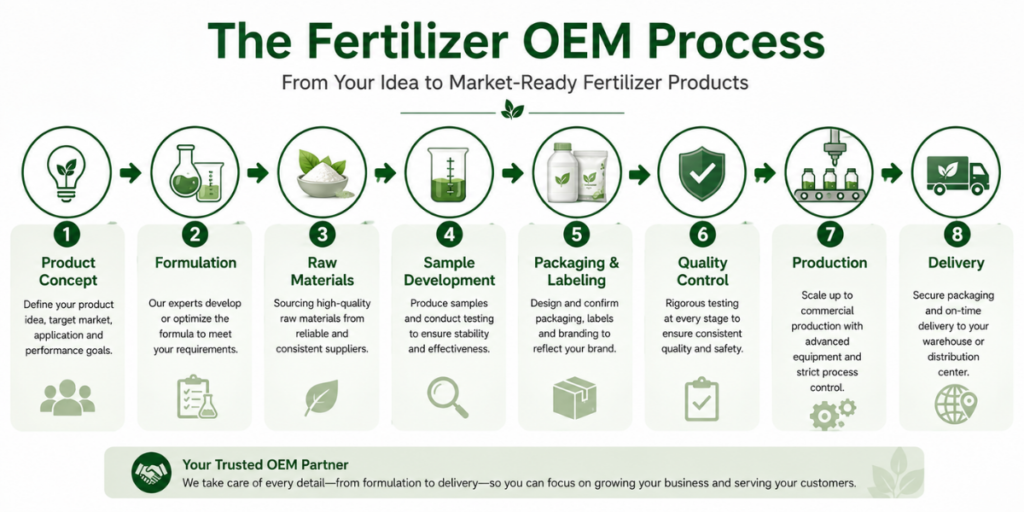
A typical project can be understood as an eight-step process:
Product Concept
↓
Formulation & Technical Review
↓
Raw Material Selection
↓
Sample / Pilot Batch
↓
Packaging & Label Development
↓
Quality & Regulatory Review
↓
Commercial Production
↓
Logistics & Delivery
Each stage can affect cost, MOQ, lead time, and the final product.
Let’s look at them individually.
Step 1: Define the Product Concept
Every successful OEM project should begin with a clear commercial objective.
Instead of simply asking:
“Can you make fertilizer?”
it is much more useful to define what the finished product is expected to do.
Important questions include:
What type of product do you need?
For example:
- Liquid fertilizer
- Water-soluble powder
- Micronutrient fertilizer
- Chelated micronutrient
- Biostimulant
- Soil amendment
- Turf nutrition product
- Foliar fertilizer
- Fertigation product
Who will use it?
The target customer may be:
- Growers
- Fertilizer distributors
- Greenhouses
- Hydroponic growers
- Turf managers
- Golf courses
- Lawn and landscape companies
- Agricultural retailers
What is the intended application?
A foliar micronutrient product may require very different formulation characteristics from a soil-applied amendment.
Understanding the end use helps determine the appropriate formulation strategy.
Step 2: Formulation & Technical Review
Once the product concept is clear, the next step is reviewing the formulation.
There are generally three situations.
Option A — Customer Provides the Formula
The customer already has a complete formulation.
The manufacturer evaluates whether the formula can be produced with the available equipment, raw materials, and manufacturing process.
Option B — Modify an Existing Formula
The customer starts from an existing product platform but requests changes.
For example:
Existing Zinc Product
↓
Increase Zn concentration
↓
Change chelation technology
↓
Add amino acids
↓
Adjust package size
This is common in private label projects.
Option C — Develop a New Formula
The customer provides the commercial target rather than the formula.
For example:
“We need a concentrated liquid micronutrient product containing zinc and manganese for foliar application.”
The formulation must then be developed around that objective.
Step 3: Select the Right Raw Materials
Raw material selection is one of the most important parts of fertilizer manufacturing.
Two products showing the same nutrient percentage on the label may behave very differently depending on the raw materials used.
Consider zinc as an example.
A manufacturer may potentially formulate with:
- Zinc sulfate
- Zinc nitrate
- EDTA-Zn
- Amino acid chelated zinc
- Citrate-complexed zinc
- Other zinc sources
These ingredients differ in characteristics such as:
- Nutrient concentration
- Solubility
- Chelation or complexation
- Compatibility
- pH behavior
- Cost
- Application positioning
This is why fertilizer formulation should not be based only on the guaranteed analysis.
The chemical form of the nutrient matters too.
From Ingredient to Finished Product
A fertilizer product is essentially the result of combining several layers of decisions:
Raw Material
↓
Formulation
↓
Manufacturing Process
↓
Quality Control
↓
Packaging
↓
Finished Product
For example:
EDTA-Zn Raw Material
↓
Micronutrient Formulation
↓
Blending / Dissolution
↓
QC Testing
↓
Bottle + Label + Carton
↓
Private Label Zinc Fertilizer
This relationship between ingredients and finished products is especially important when developing specialty micronutrient fertilizers.
A reliable ingredient supply chain helps support consistency from one production batch to another.
Step 4: Sample Development & Pilot Testing
Moving directly from an idea to full commercial production is usually not the best approach for a customized formulation.
A sample or pilot batch allows both sides to evaluate the product before scaling up.
Depending on the formulation, testing may include:
- Appearance
- Solubility
- pH
- Density
- Nutrient concentration
- Sedimentation
- Compatibility
- Storage stability
- Packaging compatibility
For powder products, manufacturers may also evaluate:
- Particle size
- Flowability
- Dissolution
- Hygroscopicity
- Caking
If the product contains multiple ingredients, physical compatibility becomes especially important.
A formula that looks good on paper does not automatically guarantee a stable commercial product.
Step 5: Choose the Packaging
Packaging should be discussed much earlier than many buyers expect.
Why?
Because packaging can directly affect MOQ, production cost, and lead time.
Typical liquid fertilizer packaging may include:
- Bottles
- Jugs
- Drums
- IBC totes
Powder products may use:
- Small pouches
- Plastic jars or buckets
- Multi-layer bags
- Kraft paper bags
- Large bulk bags
Package size also depends on the target market.
A product intended for commercial growers may use completely different packaging from one intended for lawn and garden retail.
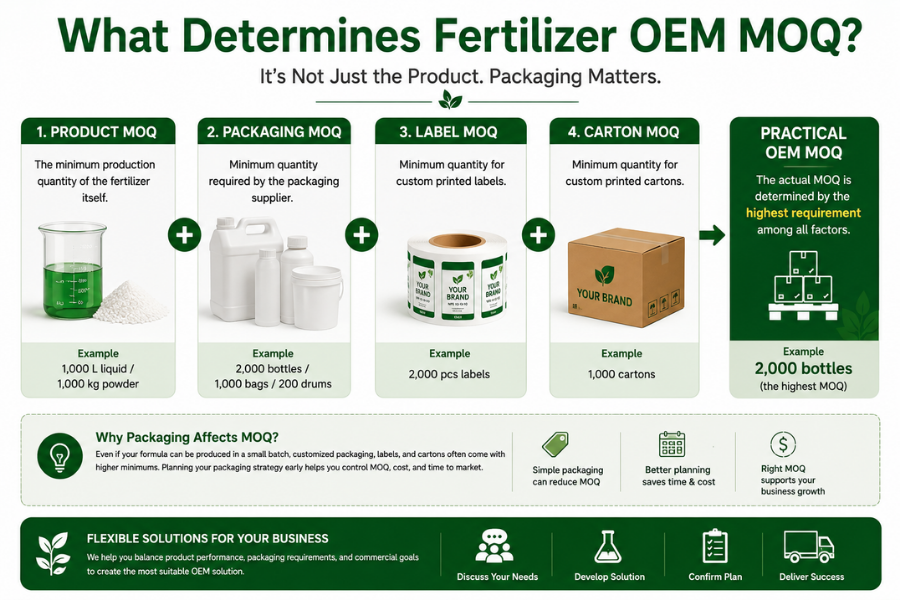
Packaging Can Determine Your MOQ
This is one of the most misunderstood aspects of fertilizer OEM manufacturing.
Customers often assume the fertilizer itself determines the minimum order quantity.
That is only part of the story.
Consider a powder fertilizer that can technically be produced in a relatively small batch.
If the customer requires a fully customized printed bag, the packaging supplier may require several thousand bags.
The effective project MOQ can therefore become much larger.
In simplified form:
Product MOQ
+
Bottle / Bag MOQ
+
Label MOQ
+
Carton MOQ
↓
Practical OEM MOQ
This is why simpler packaging can be useful for initial market testing.
For example, using a standard container with a customized label may allow a project to start at a more manageable scale than fully customized printed packaging.
Step 6: Label & Regulatory Review
A fertilizer label is not simply a marketing design.
Depending on the market, fertilizer labels may need to include information such as:
- Guaranteed analysis
- Product identity
- Net contents
- Directions for use
- Manufacturer or distributor information
- Required nutrient statements
- Precautionary information
- Registration information
Requirements differ between countries and, in some markets, between individual states or provinces.
For example, fertilizer products sold in the United States can be subject to state-level fertilizer registration and labeling requirements.
Therefore, regulatory requirements should be considered before commercial packaging is printed, not after production is complete.
This can prevent expensive label redesigns or unusable packaging inventory.
Step 7: Commercial Production & Quality Control
Once the formula, packaging, and commercial requirements are confirmed, the project can move into production.
Depending on the product, manufacturing may involve:
Raw Material Receiving
↓
Batch Preparation
↓
Blending / Reaction / Dissolution
↓
In-Process Quality Control
↓
Filling or Packing
↓
Labeling
↓
Final Inspection
↓
Finished Goods
Quality control requirements depend on the product and customer specification.
Common parameters may include:
- Nutrient content
- pH
- Density
- Moisture
- Solubility
- Appearance
- Chelated nutrient content
- Heavy metals
- Microbiological parameters where relevant
A batch-specific Certificate of Analysis (COA) can document key quality parameters for commercial shipments.
Step 8: Logistics & Delivery
Manufacturing is only part of the supply chain.
The finished product still needs to reach the customer’s warehouse or distribution network.
Depending on the project, logistics may involve:
- Palletization
- Container loading
- Domestic trucking
- Ocean freight
- Warehousing
- Third-party logistics (3PL)
- Case fulfillment
- Sample fulfillment
Packaging configuration can significantly influence freight economics.
For international projects, Incoterms such as FOB, CFR, CIF, or other agreed delivery terms should be clarified during commercial negotiations.
What Information Should You Provide When Requesting an OEM Quote?
The more complete the initial information, the faster a manufacturer can evaluate the project.
A useful OEM inquiry should ideally include:
Product
What product do you want to manufacture?
Formula
Do you already have a formula, or do you need formulation support?
Guaranteed Analysis
What nutrient concentrations are required?
Product Form
Liquid, powder, granule, or another form?
Application
Foliar, soil, fertigation, hydroponics, turf, or another application?
Packaging
What package sizes and packaging styles do you need?
Quantity
What is your estimated first order and annual volume?
Market
Where will the product be sold?
Regulatory Requirements
Are there specific registration, labeling, heavy metal, or other compliance requirements?
Providing this information early can reduce unnecessary back-and-forth communication.
Custom Formula or Existing Formula?
Not every company needs a completely new formulation.
For many businesses, there are two practical routes.
Route 1 — Existing Formula + Private Label
Best when the priority is:
- Faster launch
- Lower development complexity
- Proven manufacturing process
- More manageable initial investment
Route 2 — Custom Formula + OEM Manufacturing
Best when the priority is:
- Product differentiation
- Specific nutrient analysis
- Unique ingredient combinations
- Specific application requirements
- Building a proprietary product platform
Neither route is automatically better.
The right approach depends on the company’s market strategy.
How to Choose a Fertilizer OEM Partner
Price matters—but it should not be the only consideration.
A potential manufacturing partner should also be evaluated based on:
Raw Material Capability
Can the manufacturer source consistent raw materials and provide relevant technical documentation?
Formulation Capability
Can the facility actually produce the chemistry required by the product?
Production Capability
Does the manufacturing equipment fit the required liquid, powder, reaction, blending, or filling process?
Quality Control
What parameters are tested before release?
Packaging Capability
Can the manufacturer support the required bottles, bags, labels, cartons, and package sizes?
MOQ Flexibility
Can production and packaging quantities match the commercial stage of the project?
Documentation
Can relevant TDS, SDS, COA, and other technical documents be provided?
Communication
Can technical and commercial questions be resolved efficiently during product development?
The cheapest quotation does not always result in the lowest total project cost.
A formulation failure, packaging mistake, regulatory problem, or delayed production run can cost much more than a small difference in unit price.
A Better Way to Think About Fertilizer OEM
OEM manufacturing should not be viewed simply as:
“Find a factory → Get a price → Print my logo.”
A better model is:
Market Need
What does the customer actually need?
↓
Product Concept
What product can address that need?
↓
Ingredient Selection
Which raw materials support the desired performance and positioning?
↓
Formulation
Can those ingredients work together?
↓
Manufacturing
Can the formula be produced consistently?
↓
Packaging & Compliance
Can it be legally and commercially brought to market?
↓
Distribution
Can it reach the customer at a competitive total cost?
That is the difference between simply manufacturing fertilizer and building a commercially viable crop nutrition product.
How TerraNutrix Supports OEM & Private Label Projects
TerraNutrix works across the connection between fertilizer ingredients and finished crop nutrition products.
Our OEM and private label approach can support different stages of product development, including:
Ingredient Sourcing
EDTA chelates, EDDHA iron, amino acid-based micronutrients, citrate-based ingredients, chelating agents, phosphite ingredients, and other specialty crop nutrition materials.
↓
Product & Formulation Discussion
Evaluating product concepts, nutrient sources, ingredient options, and manufacturing requirements.
↓
Sample Development
Supporting technical evaluation before commercial production where applicable.
↓
OEM / Private Label Manufacturing
Coordinating appropriate manufacturing and packaging solutions according to project requirements.
↓
Packaging
Supporting different package formats for commercial, professional, and distribution markets.
↓
Commercial Supply
Connecting ingredient sourcing, manufacturing, quality documentation, and logistics.
Our objective is not to force every project into the same manufacturing model.
Different markets, formulations, quantities, and packaging requirements may require different production and supply-chain solutions.
From Raw Material to Your Brand
Whether you already have a complete fertilizer formulation or are starting with a product idea, the first step is understanding what needs to be manufactured.
Tell us:
What you want to make.
What market you want to sell into.
What packaging you need.
What volume you expect.
From there, we can evaluate the appropriate ingredient, formulation, manufacturing, and supply approach.