
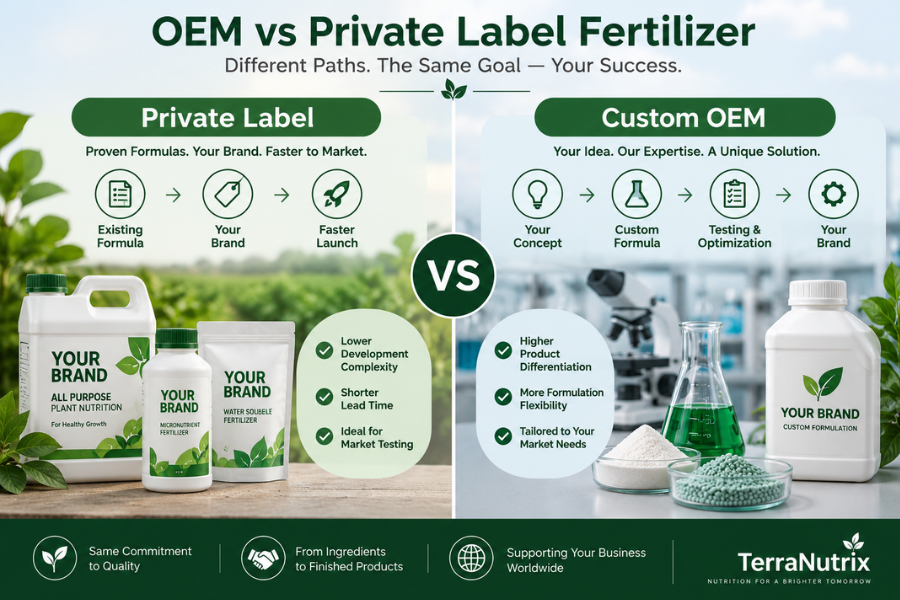
Launching your own fertilizer brand does not necessarily mean developing a completely new formula or building your own manufacturing facility.
For agricultural distributors, fertilizer brands, turf and ornamental companies, crop nutrition suppliers, and other businesses, two common routes are available:
OEM / Custom Manufacturing
and
Private Label Manufacturing
Both models allow companies to bring fertilizer products to market under their own brand, but the level of customization, development work, minimum order quantity, cost, and time to market can be very different.
Understanding these differences can help you choose a manufacturing model that fits your business rather than overcomplicating your first product launch.
What Is Private Label Fertilizer?
Private label fertilizer typically starts with an existing or established product formulation.
The manufacturer already has a product platform, and another company markets the finished product under its own brand.
Customization may include:
- Brand name
- Product name
- Label design
- Package size
- Packaging format
- Carton design
- Certain product specifications where feasible
The underlying formulation, however, generally requires little or no major development.
A simplified private label model looks like this:
Existing Formula
↓
Your Brand & Label
↓
Packaging
↓
Commercial Production
↓
Your Finished Product
For companies entering a new fertilizer category, this can be one of the fastest ways to test the market.
What Is Fertilizer OEM Manufacturing?
OEM manufacturing usually involves a higher level of product customization.
The customer may provide:
- A complete existing formula
- A target guaranteed analysis
- A competitor benchmark
- A preferred nutrient source
- A specific application requirement
- Or simply a new product concept
The manufacturer then evaluates how the product can be produced.
A typical custom OEM project may look like:
Product Concept
↓
Formula Development
↓
Raw Material Selection
↓
Laboratory Sample
↓
Testing & Adjustment
↓
Packaging
↓
Commercial Production
OEM therefore gives the customer more control over the finished product—but usually requires more technical development than private label.
OEM vs Private Label Fertilizer: Key Differences
| Factor | Private Label | Custom OEM |
|---|---|---|
| Starting Point | Existing product | Customer concept or specification |
| Formula | Existing / lightly modified | Customized |
| R&D Requirement | Low | Medium to high |
| Raw Material Selection | Mostly predetermined | More flexible |
| Sample Development | Usually simpler | Often required |
| Product Differentiation | Moderate | High |
| Development Time | Usually shorter | Usually longer |
| Technical Complexity | Lower | Higher |
| Initial Investment | Usually lower | Usually higher |
| Best For | Faster market entry | Differentiated product development |
Neither model is inherently better.
The right model depends on what you are trying to achieve commercially.
When Does Private Label Make More Sense?
Private label can be particularly useful when the priority is speed, simplicity, and market validation.
1. You Are Launching Your First Fertilizer Product
Suppose an agricultural distributor has strong relationships with growers but has never operated its own fertilizer brand.
Developing a completely new formula immediately may create unnecessary complexity.
An existing micronutrient or specialty fertilizer platform can allow the distributor to focus first on:
Branding → Sales → Distribution → Customer Feedback
rather than spending months on formulation development.
2. You Want to Test a New Market
Imagine you want to introduce a liquid micronutrient product into a regional market but do not yet know whether annual demand will be:
2,000 units
or
20,000 units.
A private label product can sometimes provide a lower-risk way to validate demand before investing heavily in proprietary formulation development.
3. You Need Faster Time to Market
A customized formulation may require:
- Raw material evaluation
- Laboratory development
- Compatibility testing
- Stability testing
- Sample approval
- Production scale-up
An existing product platform has already completed much of this development work.
Private label can therefore shorten the path from product selection to commercial production.
4. The Formula Is Not Your Main Competitive Advantage
Not every fertilizer brand needs proprietary chemistry.
A distributor may compete through:
- Local agronomic knowledge
- Dealer relationships
- Technical service
- Application recommendations
- Brand reputation
- Customer support
- Distribution efficiency
In this situation, investing heavily in a unique formulation may not provide enough additional commercial value.
When Does Custom OEM Make More Sense?
OEM becomes more attractive when product differentiation itself is part of the business strategy.
1. You Need a Specific Guaranteed Analysis
Suppose your target product requires:
Zn 6% + Mn 3% + Fe 2%
with specific chelated nutrient sources.
An existing private label product may not match that requirement.
Custom OEM allows the formulation to be built around a defined nutrient analysis.
2. You Want Specific Nutrient Sources
The nutrient percentage alone does not define a specialty fertilizer.
For example, zinc may come from:
- Zinc sulfate
- Zinc nitrate
- EDTA-Zn
- Amino acid chelated zinc
- Citrate-complexed zinc
- Other zinc sources
Iron may involve:
- EDTA-Fe
- DTPA-Fe
- EDDHA-Fe
- Amino acid-based iron
- Other iron sources
A customer targeting a particular agronomic or commercial position may therefore need control over which raw materials provide the guaranteed nutrients.
This is where custom OEM becomes much more valuable.
3. You Want to Differentiate from Competitors
Consider two products.
Product A
Standard liquid micronutrient fertilizer already available from several suppliers.
Product B
A customized micronutrient formulation designed around a specific crop, application method, water condition, or market requirement.
Product B may give the brand a stronger commercial story.
The purpose of customization should not simply be:
“We want something nobody else has.”
A better question is:
“What customer problem does this formulation solve better?”
Customization is most valuable when it supports a clear market position.
4. You Already Have a Proven Formula
Some companies already own or use successful formulations but do not want to manufacture them internally.
In this case, OEM manufacturing may provide production capacity while allowing the customer to retain its established product concept.
The manufacturer can evaluate:
- Raw material availability
- Production feasibility
- Process requirements
- Packaging
- Quality specifications
- Scale-up requirements
This is different from private label because the product begins with the customer’s formulation or specification, rather than the manufacturer’s standard product.
5. You Need a Product for a Specific Application
Different markets may require different formulation strategies.
Examples include:
High-pH Soil Nutrition
Chelating technology and micronutrient stability may become particularly important.
Turf & Ornamental
Color response, foliar compatibility, iron and micronutrient positioning, packaging, and professional application rates may influence product design.
Greenhouse & Fertigation
Solubility and compatibility with irrigation systems become critical.
Foliar Nutrition
Concentration, pH, solubility, tank compatibility, and application characteristics must be considered.
Custom OEM allows these requirements to influence formulation design from the beginning.
Private Label Does Not Always Mean “Generic”
One misconception is that private label automatically means a cheap commodity product.
That is not necessarily true.
A private label product can still use high-quality specialty ingredients such as:
- EDTA-chelated micronutrients
- DTPA-chelated micronutrients
- EDDHA iron
- Amino acid-based micronutrients
- Seaweed extracts
- Humic and fulvic materials
- Phosphite ingredients
- Other specialty fertilizer components
The distinction is primarily about how much formulation development and customization the project requires, not simply whether the product is premium or inexpensive.
Custom OEM Does Not Always Mean “Better”
The opposite misconception is also common.
A custom formula is not automatically superior simply because it is unique.
Every additional ingredient can introduce new questions:
- Is it soluble?
- Is it chemically compatible?
- Is the final product stable?
- Does it increase manufacturing cost?
- Does it create sediment?
- Does it change pH?
- Does it affect packaging compatibility?
- Does it provide enough commercial value to justify the complexity?
A simple, well-designed formulation can sometimes be more commercially successful than an unnecessarily complicated formula.
For this reason:
Customization should solve a problem—not simply add ingredients.
The Middle Ground: Semi-Custom Private Label
In practice, fertilizer manufacturing is not always divided neatly into only two models.
There is often a useful middle ground.
We can call this:
Semi-Custom Private Label
The customer begins with an existing formulation but makes limited changes.
For example:
Existing Micronutrient Formula
↓
Change Zn Source
↓
Adjust Micronutrient Ratio
↓
Add Amino Acids
↓
Select New Package Size
↓
Customer Brand
This approach can offer more differentiation than standard private label without requiring a completely new product development program.
For many growing fertilizer brands, this can be a practical option.
Three Routes to Your Own Fertilizer Product
It can therefore be more useful to think in terms of three manufacturing routes:
Route 1 — Standard Private Label
Existing Formula → Your Brand
Best for:
- Fast market entry
- New brands
- Market testing
- Lower development complexity
Route 2 — Semi-Custom Private Label
Existing Formula → Selected Modifications → Your Brand
Best for:
- Moderate differentiation
- Adjusting nutrient analysis
- Changing certain ingredients
- Balancing customization and development cost
Route 3 — Custom OEM
Your Concept / Formula → Development → Manufacturing → Your Brand
Best for:
- Proprietary formulations
- Specific nutrient sources
- Specialized applications
- Stronger product differentiation
This three-route model is often more realistic than simply asking whether a project is “OEM” or “private label.”
How Does MOQ Differ?
MOQ is another important consideration.
A custom OEM project does not necessarily have one single MOQ.
Several minimum quantities can influence the final requirement:
Product Production MOQ
Bottle / Bag MOQ
Label MOQ
Carton MOQ
=
Practical OEM MOQ
For example, a manufacturer may technically be able to produce a relatively small batch.
But if the customer requests custom-printed bottles or bags, the packaging supplier may require a much larger quantity.
Therefore, packaging strategy can sometimes influence MOQ more than fertilizer production itself.
How Can You Reduce the Initial MOQ?
For companies testing a new product, several strategies may help.
Use Standard Packaging
Instead of manufacturing a completely custom bottle or bag, use an existing package format.
Use Pressure-Sensitive Labels
A standard bottle plus a professionally printed label may require less initial commitment than fully printed packaging.
Start with an Existing Formula
Validate the market first before investing in extensive formulation development.
Limit Package Sizes
Launching 1 L, 5 L, 20 L, and 1,000 L versions simultaneously creates unnecessary inventory complexity.
Starting with one or two commercial sizes may be more practical.
Scale Customization with Sales
A brand can move gradually from:
Private Label
↓
Semi-Custom
↓
Custom OEM
as sales volume and customer feedback justify additional investment.
What About Product Ownership and Confidentiality?
This should be discussed before starting a customized development project.
Important questions may include:
- Who provided the original formula?
- Who performed the formulation development?
- Is the formulation exclusive?
- Can the manufacturer sell the same formula to others?
- Is an NDA required?
- Are there minimum purchase requirements for exclusivity?
- Who owns custom packaging artwork?
- Who is responsible for product registration?
These commercial terms can vary significantly between projects.
They should be clarified rather than assumed.
What About Fertilizer Registration?
Manufacturing a product does not automatically mean it can immediately be sold in every market.
Depending on the destination, requirements may include:
- Fertilizer registration
- Guaranteed analysis requirements
- Label review
- Heavy metal limits
- Ingredient restrictions
- Distributor or manufacturer licensing
- State or national compliance requirements
In the United States, fertilizer requirements can vary by state.
For this reason, the intended sales market should ideally be identified before finalizing the formula and printing commercial packaging.
Which Model Is Right for Your Business?
A simple decision framework can help.
Choose Private Label if:
- You want to launch quickly
- You are testing a new market
- An existing formula meets your needs
- Your primary advantage is distribution or branding
- You want to reduce development complexity
Consider Semi-Custom Private Label if:
- An existing product is close to what you need
- You want some differentiation
- You need limited changes to nutrient analysis or ingredients
- You want to avoid developing everything from zero
Choose Custom OEM if:
- You already have your own formula
- You require a specific guaranteed analysis
- You need specific nutrient sources
- Your product targets a specialized application
- Formulation differentiation is important to your brand
The right choice depends on your current commercial stage—not simply on which option sounds more sophisticated.
Start Simple, Then Build Differentiation
For a new fertilizer brand, one of the most practical strategies can be:
Step 1 — Enter the Market
Launch a commercially viable product.
↓
Step 2 — Learn
Collect feedback from distributors, dealers, agronomists, and growers.
↓
Step 3 — Identify Gaps
Understand what customers actually want changed.
↓
Step 4 — Customize
Develop a differentiated formulation based on real market demand.
↓
Step 5 — Scale
Improve packaging, production economics, and distribution as volume grows.
This approach reduces the risk of spending heavily on a highly customized product before confirming that customers actually want it.
How TerraNutrix Approaches OEM & Private Label Projects
TerraNutrix supports different product-development routes rather than assuming every customer needs a fully customized formulation.
Depending on the project, the appropriate path may include:
Private Label
Existing or established product platforms for customers seeking a faster route to market.
Semi-Custom Development
Modification of nutrient sources, concentrations, formulation components, or packaging where technically feasible.
Custom OEM
Development and manufacturing based on customer specifications, target analysis, application requirements, or existing formulations.
Our ingredient portfolio also allows OEM discussions to begin at the raw-material level, including options such as:
- EDTA chelated micronutrients
- DTPA-based ingredients
- EDDHA iron
- Amino acid chelated micronutrients
- Citrate-based micronutrients
- Chelating agents
- Phosphite ingredients
- Other specialty crop nutrition materials
This allows the discussion to move beyond:
“Which fertilizer can we put our label on?”
toward:
“What product makes the most sense for your market?”
From Product Idea to Your Brand
Whether you need a ready-to-brand fertilizer or a fully customized formulation, the first step is defining the commercial objective.
Tell us:
What product are you looking for?
Who is the target customer?
Which market will you sell into?
Do you already have a formula?
What packaging do you need?
What is your expected order volume?
From there, we can evaluate whether Private Label, Semi-Custom, or Custom OEM is the most practical route.