
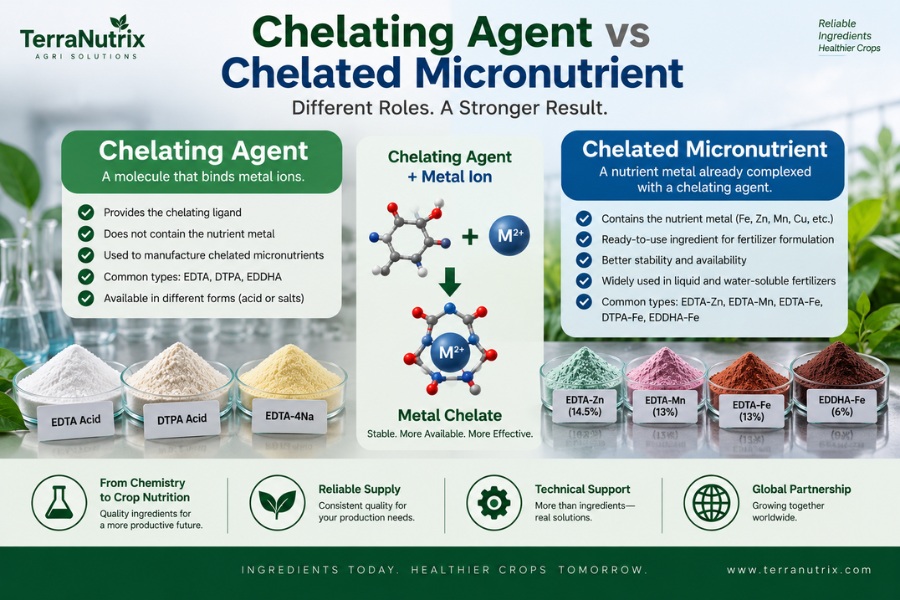
When sourcing ingredients for micronutrient fertilizer production, two terms frequently appear:
Chelating Agent
and
Chelated Micronutrient
They are closely related—but they are not the same product.
For example:
EDTA Acid is a chelating agent.
EDTA-Zn is a chelated micronutrient.
Similarly:
DTPA Acid is a chelating agent.
DTPA-Fe is a chelated micronutrient ingredient.
Understanding this distinction is important for fertilizer manufacturers because it determines whether you are purchasing a raw material for producing your own chelate or a ready-made nutrient ingredient that can be incorporated into a fertilizer formulation.
What Is a Chelating Agent?
A chelating agent is a molecule capable of binding a metal ion through multiple coordination sites.
Common synthetic chelating agents used in micronutrient chemistry include:
- EDTA
- DTPA
- EDDHA
A simplified concept is:
Chelating Agent + Metal Ion → Metal Chelate
For example:
EDTA + Zn → EDTA-Zn
or:
DTPA + Fe → DTPA-Fe
The chelating agent itself is therefore not necessarily the micronutrient fertilizer ingredient the formulator ultimately wants.
Instead, it can serve as an upstream raw material used to manufacture the chelated nutrient.
What Is a Chelated Micronutrient?
A chelated micronutrient contains a nutrient metal that has already been complexed with a chelating ligand.
Examples include:
EDTA-Zn
EDTA-Mn
EDTA-Cu
EDTA-Fe
DTPA-Fe
EDDHA-Fe
The metal provides the nutrient.
The chelating ligand helps keep that metal in a chemically controlled form under appropriate conditions.
For a fertilizer manufacturer, these materials are often much closer to being ready-to-formulate ingredients.
For example:
EDTA-Zn
↓
Add to Micronutrient Formulation
↓
Blending / Dissolution
↓
Quality Control
↓
Finished Zinc Fertilizer
This is different from purchasing EDTA and manufacturing EDTA-Zn internally.
The Difference in One Diagram
The relationship can be understood as:
Upstream
Chelating Agent
EDTA / DTPA / EDDHA
↓
+ Metal Source
Fe / Zn / Mn / Cu
↓
Intermediate Ingredient
Chelated Micronutrient
EDTA-Zn / EDTA-Mn / DTPA-Fe / EDDHA-Fe
↓
Downstream
Finished Fertilizer
Liquid Micronutrient
Water-Soluble Fertilizer
Micronutrient Blend
Specialty Crop Nutrition Product
This distinction becomes especially important when discussing ingredient sourcing with a fertilizer manufacturer.
Chelating Agent vs Chelated Micronutrient
| Factor | Chelating Agent | Chelated Micronutrient |
|---|---|---|
| What You Are Buying | Ligand / chelation raw material | Nutrient already chelated |
| Contains Target Nutrient | Usually no | Yes |
| Examples | EDTA Acid, DTPA Acid | EDTA-Zn, DTPA-Fe |
| Additional Chelation Process | Required to manufacture metal chelate | Already completed |
| Process Control Required | Higher | Lower |
| Manufacturing Complexity | Higher | Lower |
| Formulation Convenience | Lower | Higher |
| Flexibility | High | High |
| Typical Buyer | Chelate producer / advanced formulator | Fertilizer manufacturer / blender |
The choice depends largely on what manufacturing capability exists inside your facility.
Route 1: Buy the Chelating Agent and Produce the Chelate
Some fertilizer and chemical manufacturers prefer to begin further upstream.
A simplified production route might be:
Chelating Agent
Metal Source
↓
Neutralization / Reaction
↓
pH & Process Control
↓
Metal Chelate
↓
Finished Formulation
This route gives the manufacturer greater control over:
- Metal source
- Chelating-agent selection
- Reaction conditions
- Nutrient concentration
- Chelate specification
- Downstream formulation
It can also make economic sense at sufficient production scale.
However, the manufacturer must have the appropriate technical and production capability.
Route 2: Buy a Ready-Made Chelated Micronutrient
The alternative is much simpler:
EDTA-Zn
or
DTPA-Fe
↓
Formulation
↓
Finished Fertilizer
The chelation step has already been completed by the ingredient manufacturer.
This can reduce:
- Reaction complexity
- Raw-material handling
- Development work
- Process-control requirements
For many fertilizer blenders, this is the more practical approach.
A Real Example: Zinc
Suppose a manufacturer wants to develop a chelated zinc fertilizer.
There are several possible sourcing strategies.
Strategy A — Start with EDTA
Purchase the appropriate EDTA raw material and a zinc source, then manufacture the zinc chelate internally.
This provides greater process control but requires chelation capability.
Strategy B — Purchase EDTA-Zn
Purchase ready-made EDTA-Zn and incorporate it into the fertilizer formulation.
This simplifies production considerably.
Strategy C — Select Another Chelation Technology
Depending on the intended product, the manufacturer may evaluate:
- Amino acid chelated zinc
- Citrate-based zinc
- Other complexed zinc ingredients
The sourcing decision therefore starts with a broader question:
Do we want to manufacture the nutrient complex—or formulate with an existing one?
EDTA Acid vs EDTA Salts: Another Important Distinction
Even within the chelating-agent category, the chemical form matters.
A manufacturer may encounter:
EDTA Acid
EDTA-2Na
EDTA-4Na
These all belong to the EDTA family but have different properties relevant to manufacturing, particularly regarding:
- Water solubility
- pH
- Neutralization requirements
- Handling
- Liquid formulation convenience
For example, EDTA Acid provides a concentrated upstream chelating raw material but has limited water solubility.
EDTA-4Na is considerably easier to introduce into aqueous systems.
Therefore, choosing a chelating agent involves more than simply choosing “EDTA.”
The chemical form must fit the production process.
DTPA Acid vs DTPA-5Na Solution
The same principle applies to DTPA.
DTPA Acid
A high-purity solid chelating raw material suitable for manufacturers capable of managing dissolution, neutralization and chelation processing.
DTPA-5Na Solution
A water-soluble, already-neutralized DTPA salt supplied in liquid form, making it convenient for dosing into aqueous manufacturing systems.
Both provide access to DTPA chemistry.
But they fit different production processes.
What About Amino Acids and Organic Acids?
This is where terminology becomes particularly important.
Not every material used to bind or stabilize micronutrients should automatically be described as equivalent to EDTA or DTPA.
Materials such as:
- Glycine
- Compound amino acids
- Citric acid
- Gluconic acid
- Fulvic materials
can participate in metal complexation.
However, the resulting products and their stability depend strongly on ligand chemistry, metal-to-ligand ratio, manufacturing conditions and analytical definition.
For this reason, terms such as chelated, complexed, and organic-complexed micronutrient should be used carefully rather than interchangeably.
Chelation Percentage Matters Too
Seeing “EDTA” or “amino acid” in a product description is not enough to evaluate an ingredient.
Fertilizer manufacturers should ask questions such as:
- What is the total nutrient content?
- What portion is actually chelated?
- Which ligand is being used?
- What is the ligand-to-metal ratio?
- Is the product fully water soluble?
- What analytical method supports the chelation claim?
- What is the pH?
- Are there relevant impurities or heavy-metal limits?
- Is batch-to-batch quality consistent?
This is particularly important when comparing products marketed under broad descriptions such as “organic chelated micronutrients.”
How Should Fertilizer Manufacturers Choose?
The decision can begin with one question:
Does your facility manufacture chelates?
YES
Consider upstream chelating agents such as:
EDTA Acid / EDTA Salts / DTPA Acid / DTPA Salts
This can provide greater control over chelation chemistry and manufacturing economics.
NO
Consider ready-made ingredients such as:
EDTA-Zn / EDTA-Mn / EDTA-Cu / EDTA-Fe / DTPA-Fe / EDDHA-Fe
This reduces the amount of chemistry that needs to be performed during fertilizer production.
Cost Should Be Evaluated at the Process Level
Comparing only the price per kilogram of raw material can be misleading.
For example, an upstream chelating agent may appear less expensive than a finished chelated micronutrient.
But producing the chelate internally may require:
- Additional raw materials
- Reaction equipment
- Labor
- Energy
- Process time
- Quality control
- Waste management
- Technical expertise
The relevant calculation is therefore:
Raw Material Cost
Conversion Cost
Quality-Control Cost
Manufacturing Risk
=
Real Ingredient Cost
For some manufacturers, internal chelation makes sense.
For others, purchasing a ready-made chelated micronutrient is commercially more efficient.
Build the Ingredient Strategy Around the Finished Product
The best ingredient should not be selected in isolation.
Start with the finished product.
Ask:
What nutrient are we delivering?
↓
What application environment will it face?
↓
What chelation or complexation technology is appropriate?
↓
Can we manufacture that chemistry internally?
↓
Which ingredient form fits our production process?
↓
What is the total commercial cost?
This approach connects chemistry with manufacturing reality.
From Chelating Agents to Chelated Micronutrients
TerraNutrix supplies ingredients across different stages of the micronutrient manufacturing chain.
Chelating Agents
Including options such as:
- EDTA Acid
- EDTA-2Na
- EDTA-4Na
- DTPA Acid
- DTPA-5Na Solution
Chelated Micronutrients
Including:
- EDTA-Fe
- EDTA-Zn
- EDTA-Mn
- EDTA-Cu
- DTPA-Fe
- EDDHA-Fe
Organic & Amino Acid-Based Systems
Including selected amino acid and organic complexing materials and micronutrient ingredients for specialty formulation requirements.
This allows fertilizer manufacturers to source at the point in the production chain that fits their own capabilities.
Some customers need the chelating agent.
Others need the finished chelated micronutrient ingredient.
The right starting point depends on how the fertilizer is being manufactured.
Looking for the Right Micronutrient Ingredient?
If you are developing or manufacturing a micronutrient fertilizer, tell us:
Target nutrient
Required concentration
Chelation technology
Liquid or powder formulation
Production process
Required quantity
Destination market
TerraNutrix can help evaluate whether an upstream chelating agent or a ready-made chelated micronutrient is the more practical starting point.