
Why Soil Health Matters
Healthy soil is one of the most important foundations of long-term agricultural productivity.
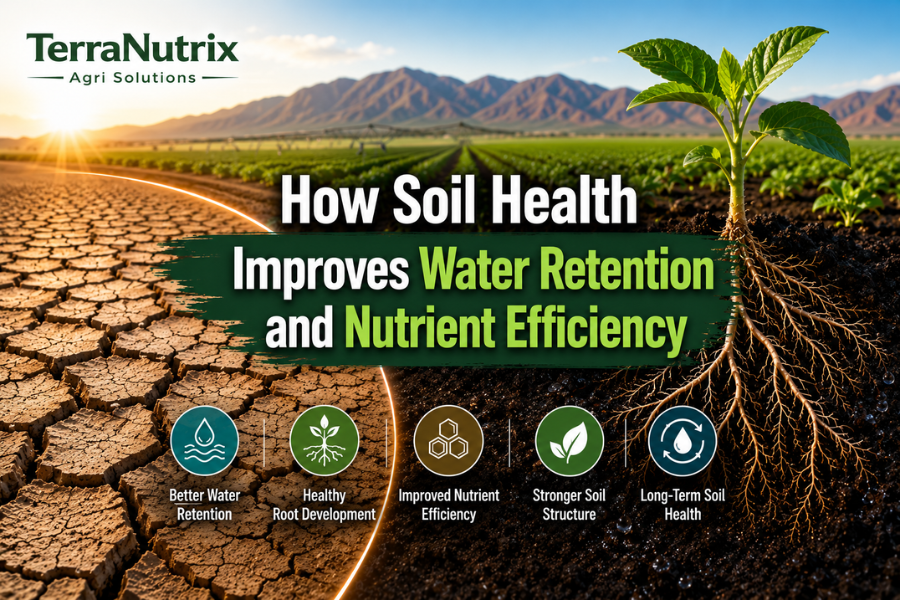
In modern agriculture, soil health influences not only crop growth, but also water retention, nutrient efficiency, root development, and overall crop resilience.
In arid and high-pH agricultural regions such as Arizona, maintaining healthy soil conditions becomes even more important.
What Is Soil Health?
Soil health refers to the soil’s ability to function as a living system that supports plant growth, water movement, nutrient cycling, and biological activity.
Healthy soil typically has:
- better soil structure
- improved aggregation
- stronger biological activity
- improved water-holding capacity
- more efficient nutrient availability
How Soil Health Improves Water Retention
One of the most important benefits of healthy soil is improved water retention capacity.
Soils with better structure and organic matter content are often able to:
- retain moisture more efficiently
- reduce water stress
- improve irrigation efficiency
- support more stable root-zone conditions
This is especially important in regions where irrigation management plays a major role in crop production.
The Connection Between Soil Health and Nutrient Efficiency
Healthy soil can also improve nutrient efficiency.
When soil structure and biological activity improve, nutrients may remain more available in the root zone instead of being easily lost through leaching or soil imbalance.
Improved soil conditions can help support:
- nutrient retention
- root nutrient uptake
- micronutrient efficiency
- balanced crop development
This becomes increasingly important under high-pH soil conditions where nutrient availability may already be limited.
Soil Health Challenges in High-pH Agriculture
High-pH agricultural systems often experience additional soil management challenges including:
- bicarbonate accumulation
- salinity stress
- nutrient lock-up
- reduced micronutrient availability
- poor root-zone performance
As a result, growers frequently integrate soil health management strategies into broader crop nutrition programs.
Practical Soil Health Approaches
Common soil health management approaches may include:
- humic substance applications
- fulvic acid programs
- organic matter support
- balanced calcium management
- irrigation management strategies
- root-zone focused nutrition programs
The goal is to support long-term soil function while improving crop performance and nutrient efficiency.
Soil Health and Arizona Agriculture
Arizona agriculture operates under demanding environmental conditions including heat, irrigation pressure, alkaline soils, and water management challenges.
Improving soil health can help support more stable crop performance under these conditions while contributing to better nutrient efficiency and water management.
Final Thoughts
Healthy soil plays a major role in water retention, nutrient efficiency, root development, and long-term crop performance.
As agricultural systems continue facing irrigation and soil management challenges, soil health will remain an increasingly important part of practical crop nutrition strategies.