
Micronutrients such as iron (Fe), zinc (Zn), manganese (Mn), and copper (Cu) are required in relatively small quantities, but their availability can have a major impact on crop growth, photosynthesis, enzyme activity, and overall plant performance.
The challenge is that simply adding a mineral to a fertilizer does not always mean that the nutrient will remain available to the plant.
Soil pH, water chemistry, interactions with other fertilizer components, and the chemical form of the micronutrient can all influence nutrient availability.
This is one reason why chelated micronutrients have become an important technology in modern fertilizer formulations.
Among the different chelation systems available, amino acid chelated micronutrients are attracting increasing attention from fertilizer manufacturers and specialty crop nutrition companies.
But how does amino acid chelation actually work, and when does it make sense to use amino acid chelates instead of EDTA or other micronutrient sources?
What Are Amino Acid Chelated Micronutrients?
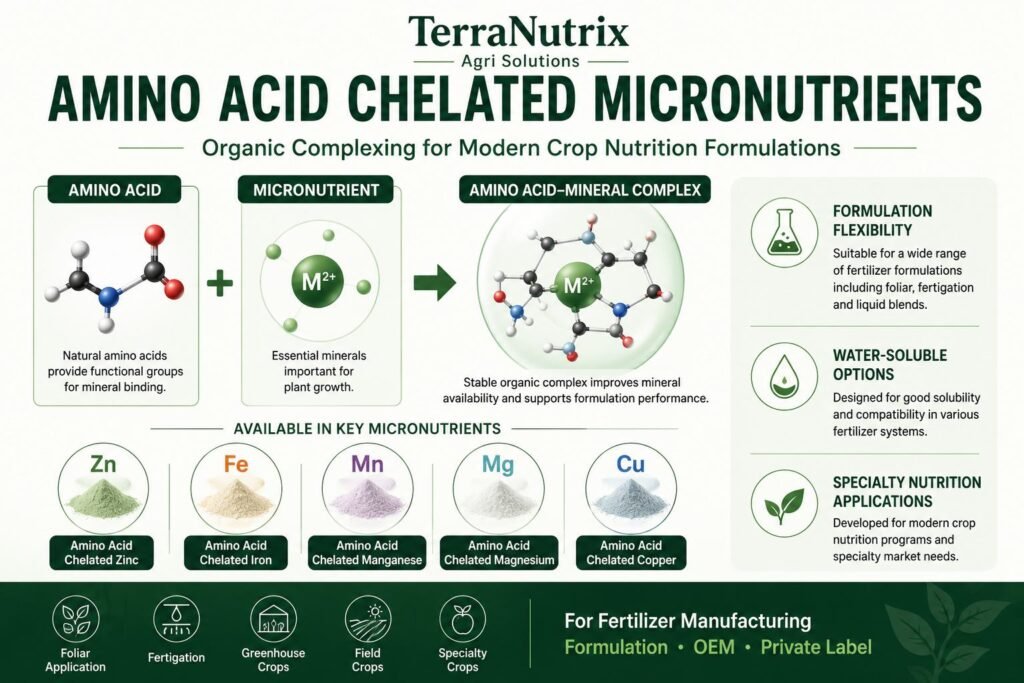
Amino acid chelated micronutrients are mineral nutrients associated with amino acid molecules through coordination with functional groups such as amino and carboxyl groups.
A simplified concept can be represented as:
Amino Acid + Mineral Ion → Amino Acid–Mineral Complex / Chelate
Common mineral elements include:
- Iron (Fe)
- Zinc (Zn)
- Manganese (Mn)
- Copper (Cu)
- Calcium (Ca)
- Magnesium (Mg)
Glycine is one of the most commonly used amino acids for mineral chelation because of its small molecular size and ability to coordinate with metal ions.
Other amino acids or amino acid mixtures may also be used depending on the manufacturing process and intended application.
How Does Amino Acid Chelation Work?
Free metal ions can react with other compounds in soil, irrigation water, or fertilizer solutions.
For example, micronutrients may become less available when they interact with hydroxides, carbonates, phosphates, or other components.
Chelation changes this behavior.
The amino acid molecule interacts with the mineral ion and forms a coordinated complex around the nutrient.
A simplified mechanism is:
Glycine + Fe / Zn / Mn / Cu → Amino Acid Chelated Mineral
The resulting mineral complex can exhibit different chemical behavior compared with the corresponding free inorganic metal ion.
This is particularly valuable when fertilizer manufacturers need micronutrient ingredients that provide a combination of nutrient delivery, formulation flexibility, and organic-ligand positioning.
Why Use Amino Acids as Chelating Ligands?
1. Organic Ligand System
Unlike synthetic chelating agents such as EDTA, amino acids are naturally occurring organic molecules.
This allows amino acid chelates to fit well into fertilizer products positioned around:
- Advanced micronutrient nutrition
- Organic-ligand nutrient delivery
- Biostimulant-compatible formulations
- Premium foliar nutrition
- Specialty crop nutrition
The exact regulatory positioning of a product, however, depends on the formulation and the requirements of the target market.
2. Good Water Solubility
Many amino acid chelated micronutrient ingredients are designed for good water solubility.
This makes them particularly useful for:
- Liquid fertilizer production
- Foliar fertilizers
- Fertigation products
- Water-soluble fertilizer blends
Solubility and compatibility should always be evaluated using the actual formulation because performance can vary according to concentration, pH, mineral source, amino acid composition, and other ingredients.
3. Suitable for Foliar Nutrition
Amino acid chelated micronutrients are frequently used in foliar fertilizer formulations.
Their combination of micronutrients and organic ligands makes them attractive for manufacturers developing high-value foliar nutrition products.
Typical examples include:
Amino Acid Chelated Zinc
for zinc-containing foliar and specialty micronutrient formulations.
Amino Acid Chelated Iron
for iron nutrition formulations.
Amino Acid Chelated Manganese
for manganese-containing crop nutrition products.
Amino Acid Chelated Copper
for specialized copper nutrition formulations.
Key Amino Acid Chelated Micronutrients
Amino Acid Chelated Iron
Iron is essential for chlorophyll formation and many plant metabolic processes.
Iron availability can become particularly challenging in alkaline and calcareous growing conditions.
Amino acid chelated iron provides fertilizer manufacturers with an organic-ligand iron option for applications such as foliar fertilizers, specialty liquid fertilizers, and multi-micronutrient formulations.
For severe iron availability problems in highly alkaline soils, stronger synthetic chelates such as EDDHA may still be more appropriate for soil-applied iron.
This is why choosing the chelation technology according to the application is important.
Amino Acid Chelated Zinc
Zinc plays important roles in enzyme systems, protein synthesis, growth regulation, and crop development.
Amino acid chelated zinc can be used in:
- Foliar fertilizers
- Liquid micronutrient products
- Fertigation formulations
- Multi-micronutrient blends
It is particularly interesting for manufacturers developing premium zinc nutrition products where an amino acid-based ligand system is desired.
Amino Acid Chelated Manganese
Manganese is involved in photosynthesis, enzyme activation, and several important metabolic processes.
Its availability can decrease significantly as soil pH increases.
Amino acid chelated manganese provides another formulation option alongside manganese sulfate, EDTA-Mn, and citrate-complexed manganese.
The appropriate choice depends on the application method, target formulation, cost structure, and required nutrient stability.
Amino Acid Chelated Copper
Copper is required in very small quantities but plays important roles in enzyme systems and plant metabolism.
Because copper can interact strongly with other compounds, controlling its chemical form can be important in specialty fertilizer formulations.
Amino acid chelated copper is therefore used in certain foliar, liquid, and specialty micronutrient products.
Amino Acid Chelates vs EDTA Chelates
One of the most common questions fertilizer manufacturers ask is:
Should we use amino acid chelates or EDTA chelates?
There is no universal answer.
They serve somewhat different formulation and market needs.
| Feature | Amino Acid Chelates | EDTA Chelates |
|---|---|---|
| Ligand Type | Amino acid-based | Synthetic chelating agent |
| Typical Positioning | Premium / organic-ligand nutrition | High-stability micronutrient delivery |
| Water Solubility | Generally good | Generally excellent |
| Foliar Applications | Very suitable | Suitable |
| Fertigation | Suitable depending on formulation | Widely used |
| Stability | Depends on metal and formulation | Generally stronger and well defined |
| High-pH Soil Performance | Application-dependent | Limited for some metals at higher pH |
| Formulation Story | Amino acid + micronutrient | Stable synthetic chelation |
Rather than asking which technology is “better,” manufacturers should ask:
Which chelation system is best suited to the intended formulation and application?
For example:
A manufacturer developing a conventional high-stability micronutrient fertilizer may prefer EDTA chelates.
A company developing a premium foliar product with amino acids and micronutrients may prefer amino acid chelates.
For iron correction in highly alkaline soil, EDDHA-Fe may be a much stronger choice than either.
Amino Acid Chelates vs Citrate Chelates
Citrate-based micronutrients represent another organic-ligand option.
Both technologies can support specialty fertilizer positioning, but their chemistry and formulation behavior differ.
Amino acid chelates are particularly attractive when manufacturers want to combine the concepts of:
Amino Acids + Micronutrients
while citrate-based products are useful when an organic-acid complexing system is preferred.
The decision should be based on:
- Target crop
- Application method
- Product pH
- Required stability
- Other formulation ingredients
- Nutrient concentration
- Desired product positioning
- Manufacturing cost
Where Are Amino Acid Chelated Micronutrients Used?
Foliar Fertilizers
This is one of the most important applications.
Amino acid chelates can be incorporated into foliar micronutrient formulations targeting crops with specific Fe, Zn, Mn, Cu, Ca, or Mg requirements.
Liquid Fertilizers
Water-soluble amino acid chelates can provide fertilizer manufacturers with flexible micronutrient ingredients for liquid formulations.
Fertigation
Selected amino acid chelated minerals can be incorporated into fertigation programs where formulation compatibility and water chemistry are appropriate.
Multi-Micronutrient Blends
Manufacturers can combine several amino acid chelated minerals to create products containing combinations such as:
Fe + Zn + Mn + Cu
This allows development of customized micronutrient packages for different crops and markets.
Biostimulant-Compatible Formulations
Amino acid chelated micronutrients can also be combined, where technically and legally appropriate, with ingredients such as:
- Amino acids
- Seaweed extracts
- Fulvic materials
- Organic acids
- Other specialty nutrient ingredients
This gives formulators considerable flexibility when developing higher-value crop nutrition products.
What Fertilizer Manufacturers Should Evaluate Before Purchasing
Not all products marketed as “amino acid chelates” are chemically identical.
This is especially important for B2B raw material purchasing.
Manufacturers should evaluate more than just the micronutrient percentage.
Important parameters include:
Mineral Content
Confirm the guaranteed concentration of Fe, Zn, Mn, Cu, Ca, or Mg.
Amino Acid Content
Understand the amino acid source and concentration.
Chelation or Complexation Rate
If a supplier claims a specific chelation rate, ask for the analytical basis and test method supporting the claim.
Solubility
Particularly important for liquid fertilizer, foliar, and fertigation manufacturing.
pH
The raw material pH can influence compatibility with the final formulation.
Heavy Metals
Request a current COA and, when necessary, independent testing for regulated contaminants.
Batch Consistency
For commercial manufacturing, consistency between shipments can be just as important as the headline specification.
Choosing the Right Amino Acid Chelated Mineral
For fertilizer manufacturers, the decision should begin with the final product rather than the raw material.
Ask:
What are we trying to formulate?
If the goal is a premium foliar zinc product, Amino Acid Chelated Zinc may be an excellent candidate.
If the goal is a multi-micronutrient liquid fertilizer, a combination of Amino Acid Chelated Fe, Zn, Mn, and Cu may be evaluated.
If the objective is correcting severe iron chlorosis in alkaline soil, EDDHA-Fe may provide a more appropriate technology.
The key is not simply using a chelated micronutrient.
The key is matching the chelation technology to the formulation, crop, application method, and growing environment.
Amino Acid Chelated Micronutrients for Fertilizer Manufacturing
TerraNutrix supplies a range of amino acid chelated micronutrient ingredients for fertilizer manufacturers, agricultural formulators, distributors, and OEM/private-label partners.
Available ingredient options include:
- Amino Acid Chelated Iron
- Amino Acid Chelated Zinc
- Amino Acid Chelated Manganese
- Amino Acid Chelated Copper
- Amino Acid Chelated Calcium
- Amino Acid Chelated Magnesium
- Customized Micronutrient Blends
Technical documentation can be provided for qualified B2B inquiries, including product specifications, TDS, COA, and available formulation information.
From Chelating Agent to Finished Micronutrient
The amino acid chelation platform also creates a clear raw-material chain:
Glycine / Amino Acid
↓
Mineral Chelation
↓
Amino Acid Chelated Micronutrient
↓
Liquid Fertilizer / Foliar / Fertigation / Specialty Nutrition Product
For fertilizer manufacturers, understanding this chain makes it easier to select not only the appropriate micronutrient ingredient but also the right chelation technology for the final formulation.
Conclusion
Amino acid chelated micronutrients offer fertilizer manufacturers a versatile approach to delivering Fe, Zn, Mn, Cu, and other mineral nutrients through an amino acid-based ligand system.
Their value is particularly relevant in premium foliar fertilizers, liquid micronutrient products, specialty nutrient formulations, and products where amino acid-based positioning is desirable.
However, amino acid chelation should not automatically be considered superior to EDTA, EDDHA, citrate, or other technologies.
Each system has its own strengths.
Successful fertilizer formulation comes from selecting the right micronutrient form for the right application.
TerraNutrix supports fertilizer manufacturers and formulation partners with multiple chelation technologies, allowing customers to evaluate amino acid, EDTA, EDDHA, citrate, and other micronutrient systems according to their specific formulation requirements.
Looking for amino acid chelated micronutrient ingredients? Contact TerraNutrix to request specifications, TDS, COA, samples, or discuss your formulation requirements.