
Fertilizer manufacturers do not always need another standard raw material supplier.
Sometimes the challenge is much more specific.
A formulation may require a particular chelated micronutrient. A current ingredient may become too expensive or difficult to source. A manufacturer may need an alternative chelating system, a different assay, better solubility, lower hygroscopicity, a specific country of origin, or simply a supplier capable of supporting a relatively small commercial volume.
This is where custom ingredient sourcing becomes valuable.
Rather than starting with a fixed product catalog, custom sourcing starts with the manufacturer’s technical and commercial requirements and works backward to identify a suitable ingredient and supply solution.
For specialty fertilizer manufacturers and formulators, this can provide much more flexibility than traditional catalog-based purchasing.
What Is Custom Ingredient Sourcing?
Custom ingredient sourcing is the process of identifying, evaluating, and supplying raw materials according to a customer’s specific formulation, manufacturing, regulatory, or commercial requirements.
For fertilizer manufacturers, these requirements may include:
- Nutrient content or assay
- Chelating or complexing system
- Powder, crystalline, or liquid form
- Water solubility
- pH or formulation compatibility
- Hygroscopicity
- Particle characteristics
- Heavy metal limits
- Country of origin
- Packaging requirements
- Minimum order quantity
- Target delivered cost
The objective is not simply to find a product with the right name.
The objective is to find an ingredient that can actually work in the customer’s formulation, production process, market, and supply chain.
Why Fertilizer Manufacturers Need Custom Sourcing
Specialty fertilizer formulations are becoming increasingly diverse.
A manufacturer producing liquid micronutrients may have very different requirements from a company producing water-soluble powders, dry blends, foliar fertilizers, fertigation products, or professional turf nutrition products.
Several common situations can trigger a custom sourcing project.
1. A Standard Ingredient Does Not Fit the Formulation
Two ingredients with similar nutrient analyses may behave very differently during manufacturing.
For example, a formulator may need to consider:
- Solubility at the target concentration
- Compatibility with other salts
- Solution clarity
- pH stability
- Precipitation risk
- Moisture sensitivity
- Storage stability
This means sourcing decisions should consider how the ingredient will actually be used, rather than specifications alone.
2. The Existing Ingredient Has Become Too Expensive
Raw material costs can change because of feedstock prices, energy costs, freight, tariffs, supply disruptions, or changes in manufacturing capacity.
In these situations, manufacturers may investigate alternative:
chelates, complexes, grades, concentrations, origins, or manufacturing routes.
The goal is not necessarily to find the cheapest ingredient. It is to identify alternatives that maintain acceptable formulation performance while improving the overall economics.
3. A Specialty Ingredient Is Difficult to Find
Some ingredients are readily available from multiple distributors. Others are produced by only a limited number of manufacturers.
Examples may include specialty:
- EDTA chelated micronutrients
- EDDHA iron
- DTPA chelates
- Amino acid chelates
- Glycinates
- Citrate complexes
- Gluconates
- Fulvic-based complexes
- Chelating agents
- Phosphite ingredients
- Biostimulant ingredients
Custom sourcing can expand the search beyond the manufacturer’s existing supplier network.
4. The Required Volume Is Between “Sample” and “Commodity”
This is a common challenge in specialty fertilizer manufacturing.
A company may need more than laboratory quantities but substantially less than a full container load.
For example, a manufacturer may need an ingredient for:
- Formula development
- Pilot production
- A new product launch
- A regional product
- Seasonal production
- Initial commercial validation
Finding the right combination of MOQ, packaging, logistics, and cost can therefore be as important as finding the ingredient itself.
Custom Sourcing Starts With the Specification
One of the most important principles in specialty ingredient sourcing is simple:
Start with the requirement, not the supplier catalog.
Consider zinc nutrition as an example.
A fertilizer manufacturer looking for a zinc ingredient may potentially evaluate:
- EDTA-Zn
- Amino acid chelated zinc
- Glycine chelated zinc
- Citrate zinc
- Gluconate zinc
- Zinc sulfate
- Other complexed zinc systems
These materials are not automatically interchangeable.
The appropriate choice depends on the intended formulation, application, concentration, compatibility requirements, cost target, and market positioning.
The same principle applies to iron, manganese, copper, calcium, magnesium, and other nutrients.
This is why a useful sourcing inquiry should include more than:
“Do you have chelated zinc?”
A stronger starting point is:
“We need a water-soluble zinc source for a liquid micronutrient formulation. Target Zn content is X%, the material must remain compatible within our target pH range, and annual consumption is approximately X tons.”
That information dramatically improves the sourcing process.
Beyond Price: How Specialty Ingredients Should Be Evaluated
Price per kilogram is important, but it can be misleading when comparing specialty fertilizer ingredients.
A more useful evaluation considers several dimensions.
| Factor | Questions to Consider |
|---|---|
| Specification | Does the material meet the required assay and chemistry? |
| Formulation Performance | Will it dissolve, remain stable, and work with other ingredients? |
| Quality | Are COA and appropriate testing available? |
| Consistency | Can future batches maintain comparable specifications? |
| MOQ | Is the commercial quantity practical? |
| Packaging | Does packaging fit the customer’s manufacturing operation? |
| Origin | Are there origin or supply-chain requirements? |
| Logistics | What is the realistic delivered cost and lead time? |
| Documentation | Are TDS, SDS, COA and other documents available? |
| Scalability | Can supply increase if the finished product succeeds? |
For this reason, the lowest FOB price does not necessarily represent the lowest usable cost.
Sample → Evaluation → Commercial Supply
A practical custom sourcing project usually moves through several stages.
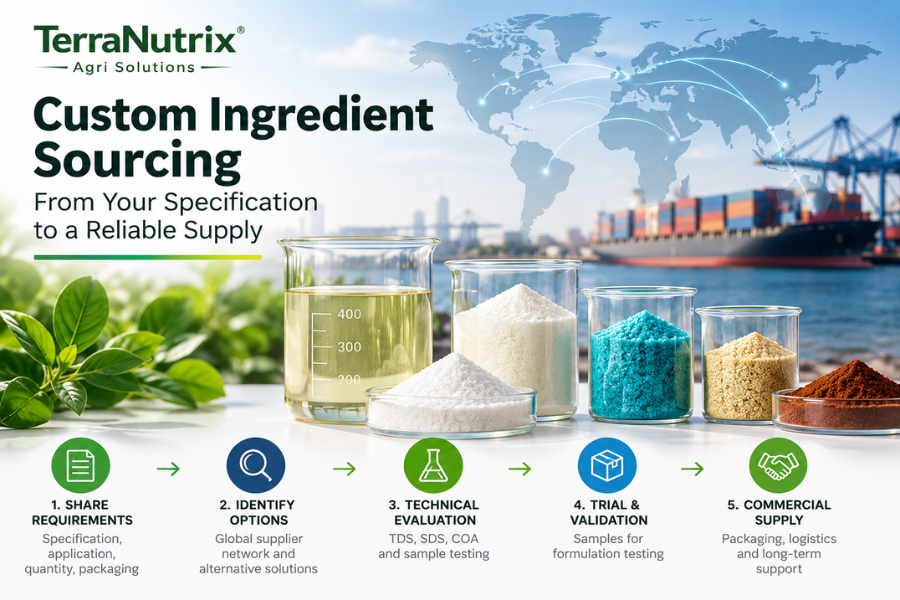
Step 1 — Define the Requirement
The customer provides the target specification, application, approximate quantity, packaging, destination, and any special requirements.
Step 2 — Identify Candidate Ingredients
Potential materials and manufacturing sources are evaluated against the requirement.
Sometimes this means finding the exact requested ingredient.
In other cases, an alternative chemistry may deserve evaluation.
Step 3 — Review Technical Documentation
Depending on the ingredient, documentation may include:
- Technical Data Sheet (TDS)
- Safety Data Sheet (SDS)
- Certificate of Analysis (COA)
- Typical specification
- Solubility information
- Heavy metal data
- Manufacturing or origin information
Step 4 — Sample and Formulation Testing
Samples allow the manufacturer to evaluate the material in the actual formulation.
This is particularly important for specialty liquids, concentrated micronutrients, mixed formulations, and products where appearance or solution clarity matters.
Step 5 — Commercial Supply
Once the material is approved, the discussion moves toward:
commercial quantity → packaging → lead time → logistics → delivered cost → repeat supply.
This creates a much more controlled path from sourcing idea to commercial production.
Where TerraNutrix Fits
TerraNutrix Agricultural Solutions LLC supports fertilizer manufacturers, formulators, and crop nutrition companies looking for specialty ingredients beyond standard catalog purchasing.
Our sourcing focus includes several major ingredient groups:
Chelated Micronutrients
EDTA, DTPA, EDDHA and other micronutrient systems.
Organic & Amino Acid Complexes
Amino acid chelates, glycinates, citrate complexes, gluconates and related specialty nutrient sources.
Chelating & Formulation Ingredients
EDTA salts, DTPA materials, glycine, organic acids and other formulation inputs.
Biostimulant Ingredients
Selected humic, fulvic, amino acid and related specialty ingredients for crop nutrition formulations.
Phosphite Ingredients
Selected phosphite raw materials for specialty fertilizer formulation.
The process can begin with either a specific ingredient name or a performance requirement.
In other words, customers do not necessarily need to know the final sourcing solution before contacting us.
What Information Should You Send With a Sourcing Request?
Providing a few basic details can significantly accelerate evaluation.
Ideally, include:
- Ingredient or function required
- Target specification or nutrient content
- Powder, crystal, granule, or liquid
- Intended formulation or application
- Estimated trial and commercial quantity
- Packaging preference
- Delivery destination
- Required documentation or testing
- Country-of-origin requirements, if applicable
- Any formulation challenge you are trying to solve
If an exact specification is not yet available, the intended application can often be a useful starting point.
From “Can You Supply This?” to “What Are You Trying to Formulate?”
Specialty fertilizer sourcing works best when the conversation goes beyond a product name.
For manufacturers and formulators, the more useful questions are often:
What are you trying to formulate?
What problem are you experiencing with the current ingredient?
Which characteristics are essential, and which are flexible?
What commercial volume will be required if the formulation succeeds?
Those questions can uncover sourcing options that are difficult to identify through a conventional catalog search.
At TerraNutrix, our goal is to connect technical requirements with practical ingredient supply — from initial evaluation and samples through commercial sourcing.