
Iron is an essential micronutrient for plants, supporting chlorophyll formation, photosynthesis, enzyme activity, and normal plant development. However, iron availability can become limited in certain soils and growing environments, particularly under alkaline conditions.
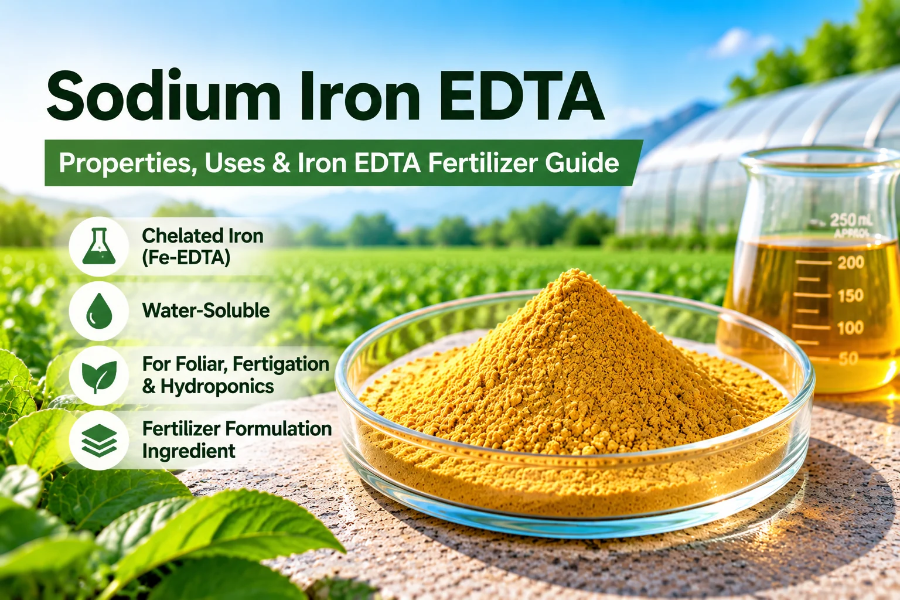
Sodium Iron EDTA, also known as Ferric Sodium EDTA or FeNaEDTA, is a water-soluble iron chelate widely used as an iron source in agricultural fertilizers and specialty crop nutrition formulations.
Its combination of iron and EDTA provides a practical ingredient for manufacturers developing liquid micronutrient fertilizers, water-soluble fertilizer blends, foliar nutrition products, and hydroponic nutrient solutions.
In this guide, we explore the chemical properties, agricultural applications, formulation considerations, and purchasing factors of sodium iron EDTA.
1. What Is Sodium Iron EDTA?
Sodium Iron EDTA is an iron(III) complex formed between ferric iron and ethylenediaminetetraacetic acid (EDTA), with sodium serving as the counterion.
It is commonly identified by the following names:
Sodium Iron EDTA
Ferric Sodium EDTA
Iron Sodium EDTA
FeNaEDTA
Iron EDTA Chelate
EDTA-FeNa
The compound is commonly supplied as a trihydrate.
Chemical Information
| Parameter | Description |
|---|---|
| Chemical Name | Ferric Sodium EDTA |
| Common Name | Sodium Iron EDTA |
| Chemical Formula | C₁₀H₁₂FeN₂NaO₈·3H₂O |
| CAS Number | 15708-41-5 |
| Molecular Weight | Approx. 421.5 g/mol |
| Iron Oxidation State | Fe(III) |
| Chemical Type | Synthetic Iron Chelate |
Unlike unchelated iron salts, sodium iron EDTA contains iron coordinated by an EDTA ligand.
This structure helps maintain iron in a soluble complex under suitable chemical conditions.
2. Typical Specifications of Sodium Iron EDTA
Commercial agricultural-grade sodium iron EDTA is commonly available with an iron content around 13%.
Typical specifications vary by manufacturer and product grade.
| Parameter | Typical Specification |
|---|---|
| Appearance | Yellow to yellow-green powder or crystals |
| Chelated Iron (Fe) | 12.5–13.5% |
| EDTA Content | 65.5–70.5% |
| pH (1% Solution) | 3.8–6.0 |
| Water Solubility | Water-soluble |
| Water-Insoluble Residue | Product-specific |
These values represent a typical commercial specification profile, not a universal guaranteed analysis.
For industrial and agricultural purchasing, always verify the actual COA and TDS for the supplied batch.
Why Is Iron Content Important?
Iron content determines how much elemental iron is supplied by a given quantity of fertilizer ingredient.
For example, a product containing 13% Fe supplies approximately 130 g of iron per kilogram of product.
However, buyers should distinguish between:
Total iron content
Water-soluble iron
Iron chelated by EDTA
These parameters may not be identical in every commercial specification.
For fertilizer manufacturers, confirming the guaranteed chelated iron content is particularly important.
3. How Does the Iron EDTA Chelate Work?
EDTA is a synthetic chelating agent capable of forming stable coordination complexes with metal ions.
In sodium iron EDTA, the EDTA ligand coordinates with ferric iron, helping maintain the metal in a soluble form.
This is important because unchelated iron can react with hydroxides, phosphates, and other components in fertilizer solutions or growing environments.
Improved Iron Solubility
Chelation helps maintain iron in solution under suitable pH conditions, making it useful in water-soluble fertilizer formulations.
Reduced Precipitation Risk
By binding iron within a chelate complex, EDTA can reduce certain precipitation reactions compared with unchelated iron sources.
However, performance depends on pH, competing metal ions, and the composition of the fertilizer solution.
Convenient Fertilizer Formulation
The water-soluble crystalline or powdered form is convenient for manufacturing liquid micronutrient products, dry fertilizer blends, and hydroponic nutrient formulations.
Controlled Nutrient Availability
The chelate helps maintain iron in a soluble form until chemical conditions permit its release and uptake by plants.
The effectiveness of this process depends on the stability of the iron-chelate complex in the intended application environment.
4. Main Agricultural Applications of Iron EDTA Fertilizer
Iron EDTA fertilizer is used in different agricultural formulations where a soluble source of iron is required.
4.1 Liquid Micronutrient Fertilizers
Sodium iron EDTA can be incorporated into liquid iron fertilizers and multi-micronutrient formulations.
Its water solubility and chelated structure make it a useful ingredient for developing specialty liquid crop nutrition products.
Formulators should evaluate final pH, concentration, and storage stability.
4.2 Foliar Iron Fertilizers
Foliar application provides an alternative method of supplying iron directly to plant foliage.
Iron EDTA chelate is commonly used in foliar micronutrient formulations designed to prevent or correct iron deficiency.
Application concentration should be adjusted according to crop sensitivity, formulation characteristics, and product label directions.
4.3 Hydroponic Nutrient Solutions
Iron is an essential component of complete hydroponic nutrient solutions.
Fe-EDTA is commonly used as an iron source in hydroponic systems operating under suitable pH conditions.
Maintaining an appropriate nutrient solution pH is important for iron-chelate stability and nutrient availability.
4.4 Water-Soluble Fertilizers
Iron EDTA can be used as an ingredient in water-soluble fertilizer formulations containing other primary and secondary nutrients.
It is particularly relevant to manufacturers producing specialty micronutrient blends and complete crop nutrition products.
Compatibility testing is recommended when combining iron chelates with concentrated fertilizer salts.
4.5 Fertigation Applications
Sodium iron EDTA can be considered for fertigation products designed to supply iron through irrigation systems.
Its suitability depends on irrigation water chemistry, solution pH, bicarbonate concentration, and other dissolved minerals.
For strongly alkaline growing conditions, alternative iron chelates may provide better stability.
5. Iron EDTA Chelate and pH Stability
One of the most important considerations when using iron EDTA chelate is pH.
Although EDTA improves iron solubility, the Fe-EDTA complex has limitations under alkaline conditions.
As pH increases, the stability of Fe-EDTA decreases, potentially resulting in iron becoming less available.
Commercial Fe-EDTA products commonly specify a practical pH stability range around 1.5–6.5, although the actual range depends on the product and testing conditions.
General Iron Chelate Comparison
| Iron Chelate | Relative Stability at Increasing pH | Typical Application Considerations |
|---|---|---|
| Fe-EDTA | Lower | Foliar fertilizers, hydroponics, compatible liquid formulations |
| Fe-DTPA | Intermediate | Hydroponics and moderately elevated pH conditions |
| Fe-EDDHA | Higher | Soil-applied iron in alkaline and calcareous soils |
For example, research summarized by the University of Florida shows that Fe-EDDHA maintains substantially greater stability than Fe-EDTA in alkaline soil conditions.
This explains why Fe-EDDHA is frequently selected for iron deficiency management in calcareous soils.
Practical recommendation:
Use Fe-EDTA where solution pH and application conditions are suitable.
Consider Fe-DTPA where greater stability is required at moderately elevated pH.
Consider Fe-EDDHA for soil-applied iron in strongly alkaline and calcareous conditions.
Selecting an iron chelate should always take into account the actual growing environment rather than iron percentage alone.
6. Sodium Iron EDTA vs. Other Iron Fertilizer Sources
Fertilizer manufacturers have several options when selecting an iron source.
Each has different chemical characteristics, nutrient concentrations, and formulation applications.
| Iron Source | Main Characteristics | Common Applications |
|---|---|---|
| Ferrous Sulfate | Inorganic iron salt | Soil and fertilizer applications |
| Ferric Sodium EDTA | Water-soluble EDTA iron chelate | Foliar, hydroponic, liquid and soluble fertilizers |
| Fe-DTPA | DTPA-chelated iron | Hydroponics and specialty fertilizers |
| Fe-EDDHA | Highly stable iron chelate at elevated pH | Alkaline and calcareous soil applications |
| Iron Citrate | Organic acid-based iron complex | Specialty liquid formulations |
Why Choose Sodium Iron EDTA?
Sodium iron EDTA is particularly useful when manufacturers need:
A concentrated chelated iron ingredient.
A water-soluble iron source.
A suitable raw material for liquid micronutrient fertilizers.
An iron ingredient for compatible hydroponic formulations.
A commercial alternative to more expensive iron chelate grades where application conditions permit.
The selection should be based on product specifications, application requirements, and total formulation cost.
7. Formulation Considerations for Fertilizer Manufacturers
When incorporating sodium iron EDTA into a fertilizer formulation, several factors should be evaluated.
Solution pH
Maintain the finished formulation within a suitable pH range for the selected iron chelate.
Ingredient Compatibility
Evaluate interactions with:
Calcium-containing fertilizers
Phosphate sources
Other chelated micronutrients
Inorganic metal salts
Organic acids and formulation additives
Dissolution and Mixing
For powder formulations, add the ingredient gradually to water with adequate agitation.
Check complete dissolution before introducing other formulation components.
Storage Stability
Evaluate the finished product for:
Precipitation
Sedimentation
Color changes
pH changes
Iron content stability
Accelerated and real-time stability testing can help determine suitable storage conditions and shelf life.
Analytical Verification
For commercial production, verify iron concentration and other relevant quality parameters through appropriate analytical methods.
8. What Should Buyers Check When Sourcing Sodium Iron EDTA?
For fertilizer manufacturers, choosing the right supplier is as important as selecting the right chemical grade.
Before placing a commercial order, consider the following:
1. Guaranteed Iron Content
Confirm whether the product contains 13% Fe or another specified concentration.
2. Chelated Iron Percentage
Verify the actual amount of iron chelated by EDTA rather than relying only on total iron content.
3. Water Solubility
Check water-insoluble residue and dissolution performance.
4. Physical Appearance
Confirm powder or crystalline characteristics, color, and consistency.
5. Technical Documentation
Request relevant documents, including:
Certificate of Analysis (COA)
Technical Data Sheet (TDS)
Safety Data Sheet (SDS)
Heavy-metal and impurity information
6. Packaging and Commercial Supply
Discuss available packaging, minimum order quantities, sample availability, and shipping arrangements.
7. Batch Consistency
For recurring commercial purchases, evaluate consistency between production batches.
These considerations help buyers select an appropriate iron EDTA chelate for their fertilizer manufacturing requirements.
9. Sodium Iron EDTA from TerraNutrix
TerraNutrix Agricultural Solutions LLC supplies specialty fertilizer ingredients and chelated micronutrients for agricultural manufacturers, formulators, and distributors.
Our iron ingredient portfolio includes:
We focus on specification-based sourcing and commercial supply coordination.
Whether you are developing a liquid iron fertilizer, a water-soluble micronutrient blend, or a hydroponic nutrient formulation, selecting the right iron source is an important part of product development.
Looking for Sodium Iron EDTA?
Contact TerraNutrix to discuss your required iron content, product specifications, packaging, order quantity, and delivery destination.
Our team can help coordinate product information, technical documentation, and commercial quotations.
Explore Our Iron Chelate Portfolio →
Request Sodium Iron EDTA Pricing →
10. Frequently Asked Questions
What is sodium iron EDTA?
Sodium iron EDTA is a ferric iron chelate in which iron is coordinated by EDTA, with sodium serving as the counterion. It is also known as ferric sodium EDTA or FeNaEDTA.
What is the CAS number of sodium iron EDTA?
The commonly referenced CAS number for ferric sodium EDTA is 15708-41-5.
What is the typical iron content of sodium iron EDTA?
A common agricultural grade contains approximately 13% iron. Commercial specifications may range from 12.5% to 13.5%, depending on the product.
Is iron EDTA fertilizer water-soluble?
Commercial sodium iron EDTA is generally water-soluble and suitable for compatible liquid and water-soluble fertilizer formulations.
Can iron EDTA chelate be used in hydroponics?
Yes. Fe-EDTA is commonly used in hydroponic nutrient solutions when the solution pH and formulation conditions are appropriate.
Is sodium iron EDTA suitable for alkaline soils?
Fe-EDTA is generally less suitable for soil application under strongly alkaline conditions. Fe-EDDHA is often preferred for soil-applied iron in calcareous soils.
What is the difference between sodium iron EDTA and ferrous sulfate?
Sodium iron EDTA supplies iron in an EDTA-chelated form, whereas ferrous sulfate supplies iron as an inorganic salt. Their solubility, chemical behavior, and suitability for different fertilizer applications are different.
Is sodium iron EDTA the same as EDTA-Fe 13%?
These names commonly refer to the same agricultural-grade iron chelate. However, buyers should verify the chemical identity and guaranteed iron content from the supplier’s technical documentation.
Conclusion
Sodium iron EDTA is an established iron chelate used in agricultural fertilizer manufacturing.
Its water solubility, chelated iron content, and compatibility with suitable fertilizer systems make it a practical ingredient for liquid micronutrient fertilizers, foliar products, hydroponic nutrient solutions, and water-soluble fertilizer blends.
However, Fe-EDTA has limitations under strongly alkaline conditions, making the selection of the appropriate iron chelate essential.
For fertilizer manufacturers and agricultural distributors, understanding the chemical properties of iron EDTA chelate helps ensure better ingredient selection and more suitable fertilizer formulations.